
 By fuyuhuaxue@iumrs.com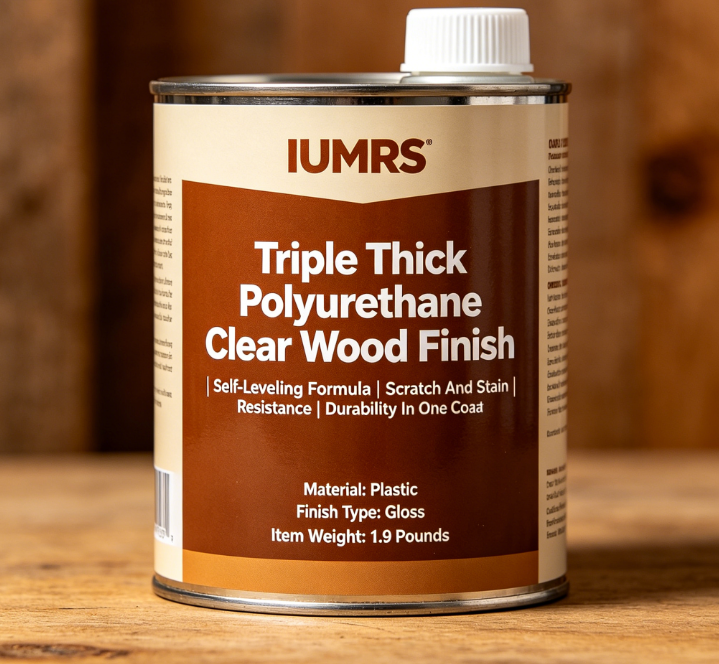
There is a specific kind of dread that every DIY enthusiast knows too well. It happens around 10:00 PM on a Sunday. You have spent your entire weekend sanding, staining, and prepping a beautiful solid wood dining table. You have mixed your polyurethane according to the instructions. You have applied the first thin, careful coat. You wait four hours. You sand again. You vacuum every speck of dust. You wipe with a tack cloth. You apply coat number two.
Then you turn on the flashlight on your phone.
You see them. Brush strokes. Tiny dust nibs. That one cat hair that floated across the room like a ninja assassin. And a run—a single, thick drip that you missed on the edge of the apron.
Your heart sinks. You know what comes next: sanding it down again. Re-coating again. Waiting another day.
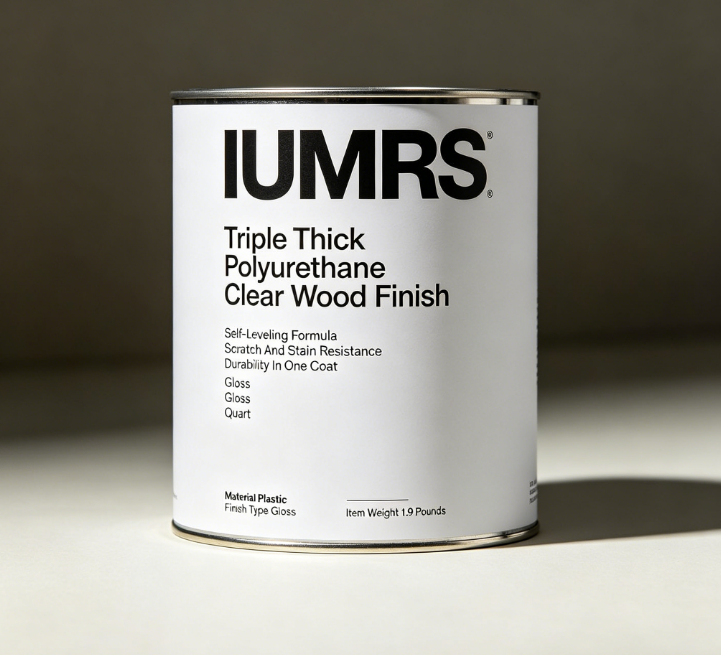
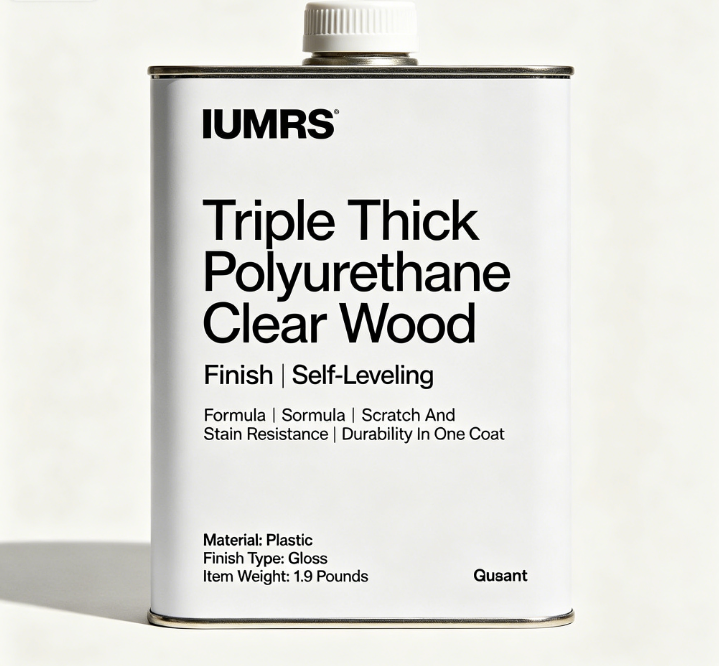
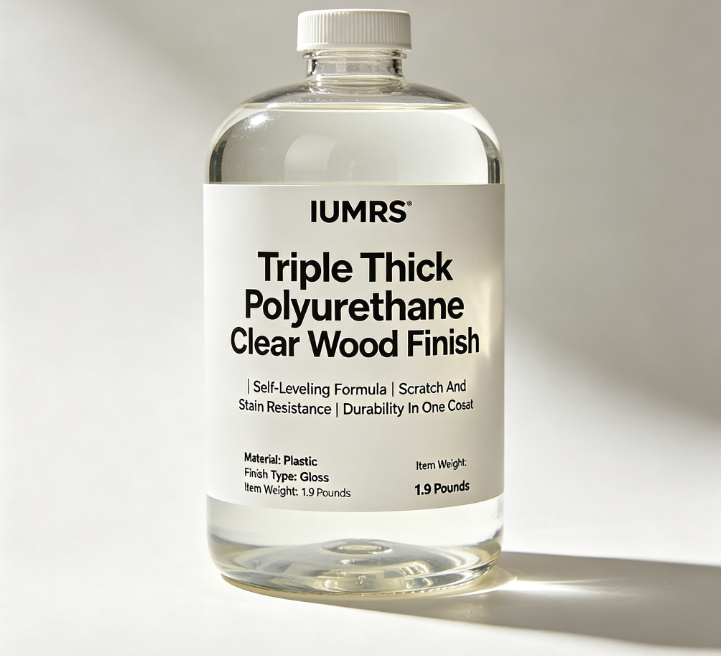
If this scenario gives you anxiety, let me introduce you to the product that is rewriting the rules of wood finishing. This is the story of Triple Thick Polyurethane Clear Wood Finish.
The Myth of the Perfect Finish
For decades, the industry told us that good things come to those who wait. We were taught that durability required layers—sometimes five, six, or seven layers of thin varnish. “Thin coats,” they said. “Build it slowly,” they said.
But the world has changed. We don’t have three days to finish a single bookshelf. We have jobs, kids, and a Netflix queue that never gets shorter. We want the protection of a bar-top finish on our dining table, but we want it today.
Enter the paradox: A water-based formula that acts like a high-solids epoxy. A one-coat solution that doesn’t look like a cheap shortcut. This is the magic of the Triple Thick formula.
What is “Self-Leveling” and Why Do You Need It?
Let’s talk about physics for just a moment. Traditional polyurethane is thick and sticky. When you drag a brush through it, it leaves ridges—high points and low points. You sand those out later. It is an act of subtraction.
Triple Thick Polyurethane works differently. The self-leveling formula has a specific viscosity that is thin enough to flow, but thick enough to build a protective film. Imagine pouring warm honey onto a pancake versus cold molasses. The honey spreads out into a perfect, smooth dome. It finds the low spots and fills them.
When you apply this finish, you will actually see the brush strokes disappear. In real-time. You brush it on, and within thirty seconds, the surface tension pulls the liquid flat. It becomes a sheet of liquid glass.
For a professional painter, this means less sanding. For a weekend warrior, this means the difference between a “passable” finish and a “piano gloss” finish. It removes the skill barrier. You don’t need to be a master finisher to get master results.
The One-Coat Argument: Fact or Fiction?
Skepticism is healthy. When a product claims “One-Coat Coverage,” most of us roll our eyes. We remember the “one-coat paint” that required two, or the “no-prime” primer that peeled.
But Triple Thick earns the claim because of a simple metric: Film Build.
A standard polyurethane applies at about 1 to 1.5 mils (thousandths of an inch) of wet film thickness per coat. To get true durability—scratch resistance, water resistance, and impact resistance—you need about 3 to 4 mils of dry film.
With standard finishes, you need three or four coats to achieve that.
Triple Thick applies at roughly 4 to 5 mils wet, which shrinks down to a robust 2–3 mils dry in a single application. You are applying the equivalent of three coats of regular poly in one swipe.
This is not a marketing gimmick. It is fluid dynamics.
Real-world test: Take a piece of pine—soft, prone to denting. Stain it dark. Apply one coat of Triple Thick. Let it dry for two hours. Now, drag your car keys across it. Press hard. You will feel the key skipping over the surface. You might see a silver mark from the key metal, but wipe it with a damp cloth? The mark disappears. The wood is untouched.
The Science of “Scratch and Stain Resistance”
Wood is porous. It is essentially a bundle of straws glued together. Stains—red wine, coffee, soy sauce—love to travel down those straws. Scratches happen when a hard object (a dog’s nail, a ceramic vase, a belt buckle) breaks the surface film and displaces the wood fibers.
Most finishes protect against one of these problems. Oil-based finishes are hard (scratch resistant) but soft (prone to chemical staining). Water-based finishes are clear (no yellowing) but often soft (scratch prone).
Triple Thick uses a hybrid resin technology. It is water-based for low VOC and easy cleanup, but the resin load is extremely high. When the water evaporates, what remains is a dense, cross-linked polymer shield.
Why this matters in your kitchen:
That island where your kids do homework? The pen ink will bead up on Triple Thick. You can wipe Sharpie off with rubbing alcohol without stripping the finish.
Why this matters in your living room:
Your dog likes to jump on the window bench to look for squirrels. Those nails? They will slide across a Triple Thick surface without leaving a trench. The hardness rating of this cured film is significantly higher than traditional hardware store poly.
The Gloss Factor: Enhancing the Natural Beauty
There is a common misconception that high gloss finishes look “plastic” or “cheap.” This is usually because the finish is applied poorly (orange peel texture) or because the finish is too thick in a bad way.
A true gloss finish, applied correctly with a self-leveling formula, does not hide the wood—it illuminates it.
Think about a guitar. A grand piano. A yacht’s helm. These things use high-gloss finishes because gloss provides depth. Gloss allows light to pass through the clear film, bounce off the wood grain, and return to your eye without scattering.
Triple Thick in Gloss is like putting a lens over your wood. If you have quarter-sawn oak with beautiful ray flecks, the gloss makes them shimmer like tiger’s eye. If you have walnut with swirling cathedral grain, the gloss adds a three-dimensional depth that matte finishes simply cannot achieve.
Because the formula is truly water-clear (no ambering like oil-based poly), the color of your stain remains true. White paints stay white. Gray washes stay gray. Natural maple doesn’t turn yellow over time.
Coverage and Speed: The 50 Sq Ft / 2 Hour Rule
Let’s do the math on a real project.
Scenario: You have a six-panel interior door (roughly 20 sq ft) and two window trims (5 sq ft each). Total: 30 sq ft.
Traditional method:
- Coat 1: Apply, wait 4 hours.
- Light sand: 30 minutes.
- Coat 2: Apply, wait 4 hours.
- Light sand: 30 minutes.
- Coat 3: Apply, wait 8 hours (overnight).
Total time to touch dry: 16+ hours. Total labor: 5 hours active.
Triple Thick method:
- Coat 1: Apply (thicker, slower strokes).
- Wait 2 hours.
- Done. Touch dry. Re-coat if you want (though you don’t need to).
Total time to touch dry: 2 hours. Total labor: 1 hour active.
That quart is rated for 50 square feet. That is roughly:
- Two full interior doors (both sides)
- OR one dining table (6 chairs)
- OR three large bookshelves
- OR 50 linear feet of baseboard trim
Because it is water-based, cleanup is soap and water. No mineral spirits. No toxic fumes (though you should still ventilate—it’s a finish, after all). You can do this in a basement workshop without gassing out the entire house.
Ideal Use Cases: Where This Product Shines
1. Furniture Flip Resurrection
Have you ever bought a solid wood dresser from Facebook Marketplace that was scratched, stained, and sad? Usually, you strip it, sand it, and then cry because you don’t have time for three coats. Triple Thick is the flipper’s secret weapon. One coat brings dead oak or maple back to life. The gloss fills in small cracks and checks, making the piece look refinished rather than just covered.
2. Kids’ Desks and Craft Tables
If you are a parent, you know the enemy: Glitter glue. Washable markers that aren’t actually washable. Play-doh oil stains. A desk finished with Triple Thick is armor. The scratch resistance means you aren’t sanding pencil marks out of the grain. The stain resistance means you can use a Magic Eraser on it.
3. Trim and Baseboards in High-Traffic Hallways
The vacuum cleaner bumping into the baseboard is the silent killer of painted trim. Standard latex paint dents. Oil-based enamel yellows. Triple Thick over a painted surface (yes, it adheres to painted wood too) creates a hard, clear shell. It acts like a sacrificial layer. The vacuum dings the poly, not the paint.
4. Bar Tops and Coffee Stations
Because it is self-leveling, it is fantastic for horizontal surfaces. The gloss finish creates that “wet look” that makes a home bar look professional. Because it is water-based, it won’t foam or bubble if you pour it a little too thick, unlike oil-based finishes that trap bubbles.
The Application Secret (Read This Before You Start)
To get the “piano gloss” result, follow these three rules:
First: Prep is still king.
Triple Thick is forgiving, but it isn’t magic. If you have a 60-grit scratch mark still visible, the gloss will magnify it like a spotlight. Sand to 180 or 220 grit. Wipe away all dust.
Second: Use a quality brush (or a foam roller).
Because you are laying down a thick coat, a cheap brush will shed bristles. Use a synthetic bristle brush (Purdy or Wooster) or a high-density foam brush. Apply in the direction of the grain. Do not over-brush. Lay it down and leave it alone. The self-leveling needs time to work.
Third: Temperature matters.
Apply between 65°F and 85°F. If it is too cold, the leveling slows down. If it is too hot, it skins over too fast. Work in the shade, not direct sun.
The Verdict: Is It Worth the Quart?
There is a reason professional woodworkers have started stocking this on their shelves alongside their expensive two-part epoxies. It isn’t that they don’t know how to do three coats. It is that time is money.
But for the home user, the value proposition is even stronger. You are buying back your weekend. You are removing the anxiety of the “second coat disaster.” You are getting professional-grade durability without the professional-grade learning curve.
The Triple Thick Polyurethane Clear Wood Finish is not a compromise. It is an upgrade. It is the recognition that modern chemistry can solve problems that our grandparents had to suffer through with steel wool and patience.
So, the next time you look at that bare wood dining table, or those sad-looking interior doors, or the kitchen island that has seen better days, ask yourself: Do I want to spend four days on this, or two hours?
Your wood is waiting. And for the first time, one quart. One coat. Done.