
 By fuyuhuaxue@iumrs.com
You’ve stared at that floor long enough. The concrete in your garage has a permanent gray pallor—stained where the car drips oil, dusted with a fine powder that reappears the day after you sweep, and cracked in places that seem to multiply every winter. Maybe it’s a basement that floods just enough to leave tide lines. Maybe it’s a workshop where sawdust and metal shavings have ground themselves into the surface like tattoos. Or maybe it’s a commercial space—a retail floor, a cafeteria, a kennel—where bare concrete announces to every customer and employee that nobody cared enough to finish the job.
A gallon of gray porch paint won’t fix this. It’ll peel within a season, and you’ll be back where you started with less money and more frustration.
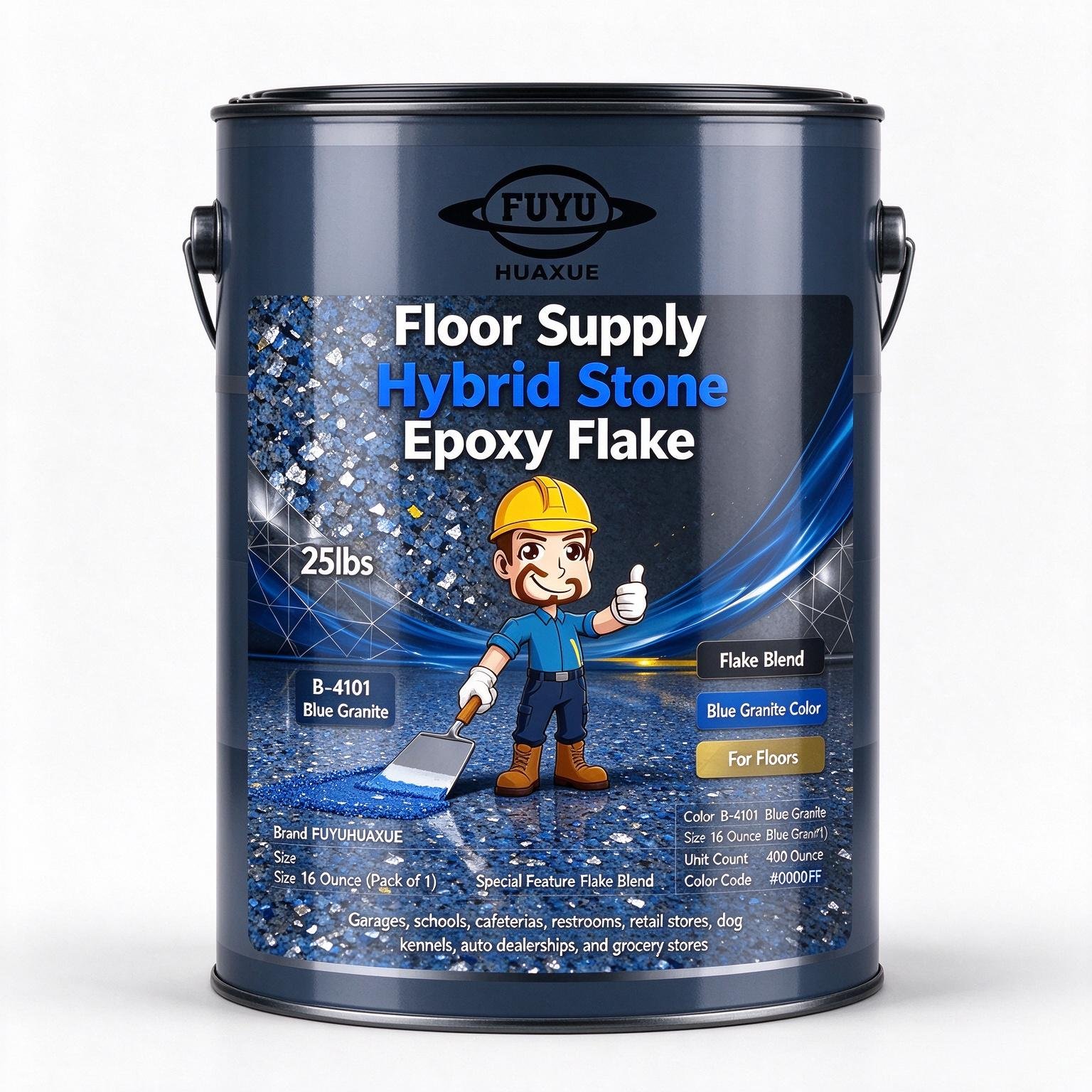
What actually works—what has worked in industrial facilities, auto dealerships, schools, and grocery stores for decades—is epoxy flake flooring. And if you’re ready to do it yourself, the FUYUHUAXUE Hybrid Stone Epoxy Flake in B-4101 Blue Granite, 25 lbs, is one of the most satisfying ways to get there.
What “Hybrid Stone” Actually Means—and Why It Matters
Not all epoxy flakes are created equal. The cheap stuff you see in big-box stores is often a single-size vinyl chip, uniform in dimension, which broadcasts across a floor like confetti at a parade. The result is flat, repetitive, and obviously synthetic. It reads as “painted floor,” not “stone floor.”
Hybrid stone flakes work differently. As the name suggests, these blends combine multiple flake sizes in a single mix, and that variation is what creates the illusion of depth. The B-4101 Blue Granite blend is a particularly good example of this principle in action. It’s built on a neutral base and incorporates accents of brown, black, grey, white, and blue, creating a harmonious palette that mimics the mineral complexity of natural granite. When these flakes are broadcast into a wet epoxy base coat and then sealed under a clear topcoat, the floor develops a three-dimensional quality that photographs poorly but looks extraordinary in person. Light catches different flakes at different angles. The surface seems to shift subtly as you walk across it.
This is the difference between a floor that looks like a floor and a floor that looks like a decision.
Why Blue Granite Works Almost Anywhere
Color choice in flooring is a deceptively difficult problem. You want something that feels intentional and design-forward, but not so bold that it fights with everything else in the room. You want something that hides dirt without looking like you’re trying to hide dirt. Blue Granite threads that needle remarkably well.
The blue tones are present but subdued—cool without being icy, present without being loud. The grey and black flakes ground the blend, keeping it from drifting into pastel territory. The white accents add brightness, which helps in spaces with limited natural light. Together, they produce a finish that reads as sophisticated and slightly industrial in equal measure, which is exactly the aesthetic sweet spot for garages, workshops, basements, and light commercial spaces.
The product’s specific use list is telling: garages, schools, cafeterias, restrooms, retail stores, dog kennels, auto dealerships, and grocery stores. That’s not a random assortment. It’s a collection of environments that share the same fundamental demands—high traffic, frequent cleaning, exposure to moisture and chemicals, and a need for surfaces that look presentable without requiring constant attention. A floor that can handle a dog kennel and still look good in a retail store is a floor that has genuinely earned its versatility.
The Performance Case for Epoxy Flake Systems
Aesthetics aside, the reason epoxy flake flooring has become a standard specification in commercial and industrial construction is performance. These systems are engineered to do things that paint and bare concrete simply cannot.
The most immediate benefit is durability. Epoxy flake systems are known for strong abrasion and mechanical resistance, which means they hold up under foot traffic, rolling loads, and the kind of incidental impact that would chip tile or scratch hardwood. The flakes themselves contribute to this; a full broadcast creates a surface that is effectively a resin-bonded aggregate, distributing wear across thousands of small particles rather than concentrating it on a single smooth film.
Chemical and moisture resistance is the second pillar. Concrete is porous. It absorbs water, oils, de-icing salts, and cleaning chemicals, and over time, that absorption leads to spalling, efflorescence, and structural deterioration. A properly applied epoxy flake system creates a seamless, impermeable barrier. The surface resists common detergents and cleaning agents, making it suitable for regular sanitation routines. Spills wipe up instead of soaking in. This is particularly relevant in restrooms, cafeterias, and kennels, where moisture and biological waste are constant presences.
Then there’s the question of appearance retention. One of the less-discussed advantages of flake systems is their ability to mask the visual evidence of wear. A solid-color epoxy floor shows every scuff, every tire mark, every patch of ground-in dirt. A flake floor doesn’t. The multi-colored, multi-dimensional surface breaks up visual uniformity, so traffic patterns and minor abrasions simply disappear into the pattern. This means the floor looks newer for longer, and you spend less time worrying about it.
Coverage, Coverage, Coverage: What 25 Pounds Actually Gets You
Here’s where a lot of DIY flooring projects go wrong. People buy the epoxy, they buy the flakes, and they underestimate how much flake material they need for the finish they want. The result is a sparse, patchy broadcast that reveals the base coat underneath and looks nothing like the rich, stone-like finish they had in mind.
Full broadcast—the technique that creates the dense, fully covered granite appearance—is flake-hungry. Industry guidance is consistent on this point: a full broadcast floor typically consumes over 25 lbs of flakes per 250 square feet. This 25 lb package is sized for exactly that kind of serious application. It’s not a token amount for a light sprinkle. It’s the quantity you need to do a proper full broadcast on a focused project area—a single-car garage bay, a compact workshop, a basement room, or a section of commercial floor where the finish quality matters.
If you’re working with a larger space, multiple packages can be combined, but the 25 lb format is a smart starting point for a first project. It’s enough material to develop your technique and see the full visual payoff without committing to a pallet of flakes you may never use.
What Installation Actually Looks Like
There is a persistent myth that epoxy flooring is mysteriously difficult—that it requires specialist knowledge and equipment beyond the reach of ordinary homeowners. It doesn’t. It requires patience, preparation, and respect for the process. The process itself is straightforward.
Surface preparation comes first, and it’s non-negotiable. The flakes and epoxy will bond only to a surface that is clean, dry, and profiled. Concrete should be free of oil, grease, dust, curing compounds, and loose material. For most residential garages and basements, a combination of degreasing, scrubbing, and acid etching or diamond grinding will do the job. The surface should feel like 100-grit sandpaper—slightly rough, not smooth. If you can’t achieve that with chemical prep, mechanical grinding is the reliable alternative.
Once the surface is ready, the primer goes down. This is a thin coat that seals the concrete and creates a consistent base for the epoxy. It’s tempting to skip this step. Don’t. Primer is what prevents the base coat from being absorbed unevenly into the concrete, and it’s the foundation of adhesion.
The base coat comes next—a pigmented epoxy applied with a roller or squeegee. While it’s still wet, you broadcast the flakes. The technique matters here. The flakes should be thrown or poured in a manner that allows them to fall onto the floor at a consistent density, rather than dumped in piles or scattered haphazardly. Working in manageable sections and maintaining a systematic broadcast pattern produces the even, full coverage that defines a quality flake floor.
After the epoxy cures—typically 12 to 24 hours, depending on temperature and humidity—you scrape or sweep off the excess flakes. A surprising amount of material will come up; this is normal and expected. The loose flakes have done their job of ensuring full coverage, and the ones that didn’t bond can be discarded.
Finally, the clear topcoat seals everything in. This is what gives the floor its protective shell and its gloss. Some systems use a single seal coat; heavier-duty applications may use two. The topcoat is what you’ll walk on, clean, and look at for years to come.
Where This Floor Makes Sense
The application list for this product—garages, schools, cafeterias, restrooms, retail stores, dog kennels, auto dealerships, grocery stores—describes spaces that share a common DNA. They are hard-working environments. They get dirty. They get wet. They get cleaned aggressively. They need floors that can take punishment without looking punished.
In a garage, the Blue Granite flake system transforms a space that is often treated as an afterthought into something that feels intentional. Oil drips wipe up. Tire marks disappear into the pattern. The floor stops being a source of dust and starts being a surface you don’t mind looking at.
In a basement, the waterproofing aspect is the headline. A flake epoxy floor creates a moisture barrier that protects the concrete slab and makes the space feel cleaner, drier, and more finished. For laundry areas, home gyms, or storage rooms, it’s a practical upgrade with an outsized visual impact.
In commercial settings—retail floors, cafeteria lines, restroom areas, kennel runs—the combination of chemical resistance, easy cleanability, and appearance retention translates directly into lower maintenance costs and a better customer experience. A floor that still looks good after a year of heavy use is a floor that’s paying for itself.
The Bottom Line
Concrete is a remarkable material. It’s strong, it’s cheap, and it lasts virtually forever. What it lacks is finish—the visual and tactile quality that makes a space feel cared for. Epoxy flake flooring is the most cost-effective way to add that finish, and the FUYUHUAXUE Hybrid Stone Epoxy Flake in B-4101 Blue Granite is a well-considered entry point into that category. It’s a 25 lb package of design and durability, sized for real projects and capable of producing a floor that looks like it cost several times what you actually paid. Blue Granite, as a blend, is timeless for a reason: it works with everything, hides everything, and impresses everyone.