
 By fuyuhuaxue@iumrs.com
Every vehicle, every trailer, every piece of heavy equipment has a part that determines whether it is worth saving—and almost nobody looks at it until it is too late.
It is the frame. The chassis. The structural skeleton that carries every load, absorbs every shock, and holds every component in alignment. It is also the part most exposed to road salt, gravel, standing water, and decades of neglect. Body panels get washed and waxed. Interiors get vacuumed and detailed. The frame sits underneath, quietly oxidizing, until the day a mechanic puts the vehicle on a lift and finds the corrosion that has been growing from the inside out.
That is the day the conversation changes. Rust in a rocker panel is a cosmetic problem. Rust in a frame rail is a structural one. And structural corrosion is the reason vehicles get scrapped that otherwise had years of service left in them—not because the engine failed, not because the transmission gave out, but because the metal that held everything together quietly dissolved.
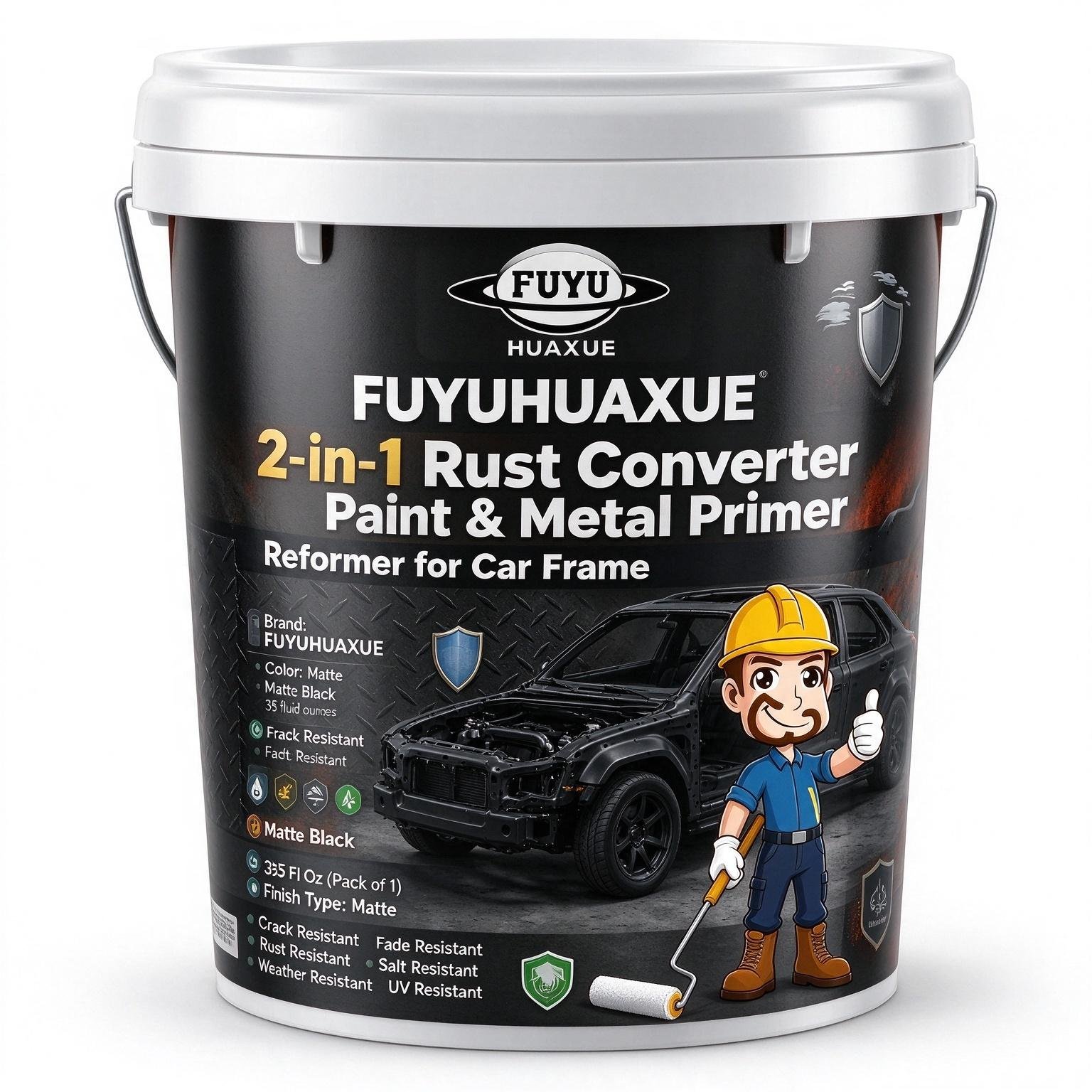
FUYUHUAXUE’s 2-in-1 Rust Converter Paint & Metal Primer exists for exactly that part of the vehicle. Supplied in a 35-fluid-ounce container in matte black, this is a rust reformer formulated to be painted directly over rust—no primer, no topcoat, no sanding to bare metal—converting existing corrosion into a tough, smooth, black coating and sealing the surface against moisture and salt with a heat-stable, impact-resistant, peel-proof barrier.
It is not a cosmetic refresh. It is a structural decision.
Matte Black: The Honest Finish for Structural Metal
The finish is matte black, and for frames and chassis, that is the correct choice rather than a compromise.
Matte black is the traditional finish of underbody metal for practical reasons. It does not show the dust, road grime, and salt film that accumulate on a chassis in normal service. It does not highlight the imperfections that are inevitable on a welded, stamped, forty-year-old frame. It reads as structural, deliberate, and maintained. And in the specific case of a coating applied over converted rust, a matte film is more forgiving of the subtle surface variation that remains after conversion—whereas a high-gloss film would magnify every irregularity.
The matte designation also signals the product’s intent: this is a working coating for working metal. It is meant to be applied to a truck frame, a trailer chassis, a piece of industrial equipment, or an outdoor structure—not to a show car’s hood. The result the specification describes is a tough, smooth, black coating—a surface that looks properly treated because it is.
Permanently Prevent Rust: Paint Directly Over Rust
The central claim of this product is stated without hedging: permanently prevent rust.
That is a strong word, and it is supported by a specific mechanical description. The formulation converts rust into a tough, smooth, black coating and creates a heat-stable, impact-resistant, and peel-proof barrier that seals out moisture & salt to stop corrosion for good.
Three properties are doing the work here, and each addresses a distinct failure mode:
Heat-stable. Frames, chassis, and underbody components cycle continuously between ambient temperature and the heat radiated from the engine, exhaust, and braking system. A coating that softens, blisters, or loses adhesion under thermal cycling opens the door to moisture. Heat stability maintains the barrier across that cycle.
Impact-resistant. Underbody metal is struck constantly—by gravel, by debris, by tools, by jack stands, by the road itself. A coating that chips under impact creates a breach, and a breach is where corrosion restarts. Impact resistance is what keeps the barrier continuous in real service conditions.
Peel-proof. Peeling is the classic failure of coatings applied over poorly prepared or unstable substrates. A film that lifts at an edge or a seam allows moisture to migrate beneath it, where it is trapped against the metal—turning the coating into a corrosion chamber rather than a barrier. Peel-proof adhesion to the converted rust surface is what prevents that failure mode.
Together, these three properties explain why the product can be described as stopping corrosion for good rather than merely slowing it down. The chemistry neutralizes the existing corrosion; the film excludes the moisture and salt that would restart it; and the film’s physical toughness preserves the exclusion over time.
Direct-to-Rust Paint: The Specification That Changes the Labor Equation
The most practically significant line in the product’s technical description is a single quantified claim: one coat converts 50μm rust with peel-proof adhesion.
Fifty micrometers is a meaningful depth of corrosion. It is not surface staining—it is rust that has developed enough volume and depth to have begun undermining the metal. A formulation rated to convert rust at that depth is addressing real corrosion, not merely discoloration. And it does so with peel-proof adhesion, which is the property that makes conversion meaningful rather than cosmetic.
Alongside that specification is the operational instruction that defines the product’s role: No Primer / Topcoat / Sanding Needed.
This eliminates three separate stages of conventional rust repair, and each elimination matters:
No sanding to bare metal. Sanding is the most labor-intensive step in rust repair, and it is also the least reliable—because no abrasive can reach the bottom of a rust pit, the interior of a welded seam, or the inside of a box section. A product that converts sound rust rather than requiring its removal does not need to reach those places. It needs only to contact them.
No primer. The converted film is the primer. There is no separate product, no separate application, and no interface between layers where adhesion can fail.
No topcoat. The converted film is the protective finish. For a frame, a chassis, a trailer, or an industrial structure, the matte black surface is the finished surface—no additional coating is required.
The specification notes the result plainly: Trusted by Pros & DIYers. That is the correct framing. The same properties that make the product practical for a first-time user working with a brush in a driveway—no specialist preparation, no multi-product system, no professional skill required—are what make it efficient for a professional shop that needs to move vehicles through the bay quickly.
Defy 350°F Heat: Thermal Shock, Salt, UV, and Corrosion
The specification states that the coating withstands extreme thermal shock, salt, UV & corrosion—and rates the product to 350°F.
Thermal shock is a more demanding condition than steady heat. It describes the rapid cycling between hot and cold: the brake components that go from ambient to several hundred degrees and back, the exhaust-adjacent brackets that heat and cool with every drive, the frame rails that radiate heat from the drivetrain and then sit in freezing weather overnight. Materials expand and contract at different rates under these cycles, and coatings that are not formulated for it develop cracks, blisters, and adhesion failures. Resistance to thermal shock is what allows the coating to remain continuous through the cycles that define real vehicle service.
Against salt, the coating is formulated to seal out the electrolyte that drives corrosion—relevant for coastal vehicles, winter-road vehicles, and any equipment exposed to de-icing brine. Against UV, the formulation resists the degradation that breaks down exterior coatings and opens micro-cracks for moisture ingress. Against corrosion, the conversion chemistry neutralizes existing oxide while the barrier excludes the reactants for future oxidation.
The framing in the specification is direct and worth repeating: so rust never cuts your automotive longevity short. That is the real stakes of chassis corrosion. It is not appearance. It is longevity—the number of years a vehicle or a piece of equipment remains serviceable, structurally sound, and worth maintaining.
Built to Last for All: The Application Range
The specification describes the product as a lifetime-durable rust encapsulator that converts and bonds to lock out corrosion, permanently protecting heavy-duty trucks, trailers, frames, industrial/marine equipment & outdoor structures.
Heavy-duty trucks. Frame rails, crossmembers, suspension brackets, spring hangers, and fifth-wheel mounting plates. These are high-value, high-stress components where corrosion is both expensive and dangerous.
Trailers. Frames, tongue jacks, A-frames, bed supports, and ramp hardware. Trailers are routinely dunked in water, exposed to road salt, and stored outdoors—conditions that accelerate corrosion and where replacement cost is significant.
Frames. The product’s named specialty. Automotive frames, chassis, subframes, and structural brackets benefit from a coating designed for exactly this geometry—accessible in some places, inaccessible in others, with seams and welds that trap moisture.
Industrial equipment. Equipment frames, housings, guards, and mounting structures exposed to process chemicals, humidity, and abrasion.
Marine equipment. Above-water and splash-zone metal on vessels, trailers, dock hardware, and marine structures facing salt spray and constant humidity.
Outdoor structures. Railings, gates, steel fencing, and structural metalwork exposed to weather year-round.
Across all of these, the product’s combination of properties—direct application over rust, no primer or topcoat, heat stability, impact resistance, peel-proof adhesion, and matte black finish—maps onto the practical realities of maintaining metal that must stay in service.
The Full Feature Stack: Crack, Fade, Salt, UV, Weather, Non-Toxic
Beyond the headline claims, the specification lists a set of properties that together define the product’s durability envelope.
Crack resistant. Cracks are entry points for moisture and oxygen. A crack-resistant film preserves the continuity of the barrier through thermal cycling and mechanical flexing.
Fade resistant. Black coatings exposed to sun are prone to chalking and fading. Fade resistance keeps the finish looking correct—relevant on visible structures like railings and gates as well as on underbody components.
Non-toxic. A practical advantage for anyone applying the product in a home garage, a workshop, or an enclosed space. The reduced hazard profile makes the product genuinely usable in the settings where rust repair actually happens.
Salt resistant. The specific protection required for coastal, marine, and winter-road environments.
Weather resistant. Resistance to rain, humidity, temperature cycling, and the general assault of outdoor exposure.
UV resistant. Resistance to the degradation that breaks down exterior coatings over time.
Rust resistant. The core function, supported by all of the above.
The combination is what distinguishes a durable coating from a hopeful one. A rust coating that resists salt but fades and cracks under UV will fail. One that resists UV but chips under impact will fail. This formulation is specified to resist the full set of degradation mechanisms simultaneously.
The Zero-Risk Promise
One final element of the specification is worth noting because it is unusual in the coatings category: the Zero-Risk Promise.
The manufacturer states: Return or replacement if our Rust Inhibitor & Neutralizer isn’t what you expected. We use it, we trust it, you risk nothing.
For a product applied to expensive equipment—a truck frame, a trailer chassis, a piece of industrial machinery—that commitment carries real weight. Coatings are a category in which the customer usually bears the risk of failure: if the product does not perform, the metal is already coated, the labor is already spent, and the corrosion is already progressing. A return-or-replacement commitment shifts that risk back to the manufacturer, and it signals confidence in the chemistry.
Conclusion: Protect the Part That Decides Everything
The frame is the part no one sees and the part that determines whether a vehicle, a trailer, or a piece of equipment is worth keeping. It is also the part most exposed to the corrosion that quietly ends service life.
FUYUHUAXUE’s 2-in-1 Rust Converter Paint & Metal Primer is built for that part. Matte black. Direct-to-rust application. No primer, no topcoat, no sanding to bare metal. One coat converts 50μm of rust with peel-proof adhesion. Heat-stable to 350°F and resistant to thermal shock, salt, UV, and corrosion. A tough, smooth, impact-resistant barrier that seals out moisture and salt—specified for heavy-duty trucks, trailers, frames, industrial and marine equipment, and outdoor structures.
Convert the rust. Seal the metal. Keep the frame that holds everything together.
FUYUHUAXUE 2-in-1 Rust Converter Paint & Metal Primer—matte black, 35 fluid ounces, and a barrier built to outlast the corrosion it was applied to stop.