
 By fuyuhuaxue@iumrs.com
In heavy industry, manufacturing, and long-term asset storage, the margin for error is zero. A single rusted bearing can seize a production line. A corroded electrical connector can ground an aircraft. Oxidized aluminum can ruin the finish of a precision component before it ever leaves the warehouse. Rust is not merely a cosmetic concern—it is a relentless, electrochemical force that attacks metal at the molecular level, and it waits for every lapse in protection.
For decades, maintenance engineers and preservation specialists have relied on a specific class of products to hold that force at bay: evaporative solvent rust preventatives. These are not paints, not greases, and not temporary oils. They are precision-engineered chemical films that evaporate quickly, leave a thin, tenacious barrier, and protect metal through the harshest conditions imaginable. And among this specialized category, one product stands out for its balance of military-grade compliance, extraordinary endurance, and practical industrial usability.
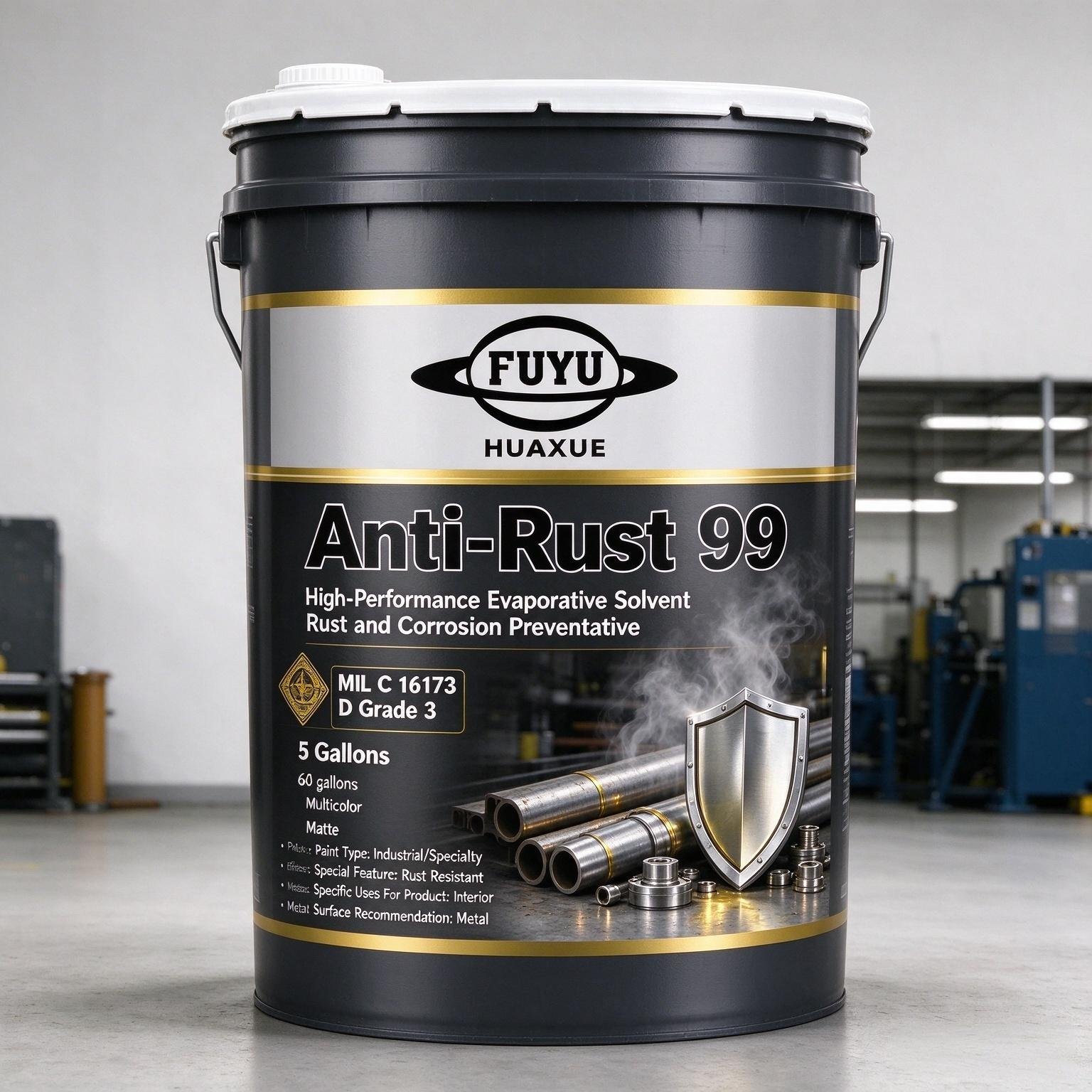
That product is Anti-Rust 99 by FUYUHUAXUE—a high-performance evaporative solvent rust and corrosion preventative supplied in a substantial 5-gallon container (640 fluid ounces) and manufactured to the demanding MIL C 16173 D Grade 3 specification.
This is not a product for casual workshop use. This is a product for operations where failure is not an option—where a 3,150-hour humidity test is not a marketing claim but a baseline requirement.
The Problem with Ordinary Rust Preventatives
Before understanding why Anti-Rust 99 is different, it is worth understanding why most rust preventatives fail.
Conventional rust inhibitors often fall into one of two camps. The first camp is oil-based products. These are easy to apply, but they migrate, wash away, and offer limited protection in humid or salt-laden environments. They also attract dust and dirt, turning protected surfaces into grimy messes that require extensive cleaning before use. The second camp is heavy grease or wax coatings. These offer better barrier protection, but they are difficult to apply evenly, impossible to apply to intricate assemblies without bridging or clogging, and require aggressive solvents to remove.
Evaporative solvent rust preventatives solve these problems by design. They are formulated as low-viscosity liquids that penetrate crevices, displace moisture, and then evaporate rapidly, leaving behind a thin, dry-to-touch film. That film is the actual protective barrier—a microscopically thin layer that seals the metal surface from humidity, salt spray, acid fumes, and fingerprint oils.
Anti-Rust 99 is a premium example of this chemistry. It is supplied as a multicolor, matte-finish liquid in a 5-gallon pail, making it suitable for dip, spray, or brush application across large surface areas or high-volume production lines. When the solvent carrier evaporates, the result is a dry, non-tacky film that resists mechanical wear and does not attract contaminants.
The Numbers That Matter: 3,150 Hours and 88 Hours
In the world of corrosion testing, vague claims are worthless. Performance must be measured, and the measurements must be repeatable. Anti-Rust 99 is backed by two test results that separate it from commodity rust preventatives.
First: 3,150 hours of protection at 100°F and 100% relative humidity, tested according to ASTM D-1748.
ASTM D-1748 is the standard test method for rust protection by metal preservatives in the humidity cabinet. To appreciate what 3,150 hours means, consider this: 3,150 hours is more than 131 days of continuous exposure to saturated air at elevated temperature. In such an environment, unprotected steel will begin to rust within hours. Many commercial rust preventatives fail within 500 to 1,000 hours. Anti-Rust 99 more than triples the performance of typical products and pushes into the territory of aerospace and military preservation standards.
Second: 88 hours of salt spray resistance.
Salt spray testing (typically ASTM B-117) is the gold standard for evaluating corrosion resistance in marine and coastal environments, as well as for evaluating the effects of road de-icing salts. Eighty-eight hours of salt spray resistance is a strong result for a thin-film evaporative preventative. It means that parts protected with Anti-Rust 99 can withstand extended exposure to salt-laden atmospheres without developing red rust or white corrosion on aluminum surfaces.
These two numbers alone tell a story: Anti-Rust 99 is engineered for environments where ordinary products surrender.
MIL C 16173 D Grade 3: What It Means and Why It Matters
The specification MIL C 16173 D Grade 3 is not a marketing badge. It is a military specification that defines the performance requirements for solvent-diluted, corrosion-preventive compounds. Grade 3 specifically refers to a formulation that leaves a thin, dry film—suitable for applications where a heavier, oily, or waxy film would be undesirable.
Compliance with MIL C 16173 D Grade 3 means that Anti-Rust 99 has been formulated to meet rigorous government standards for:
- Film thickness and uniformity
- Corrosion protection under humidity and salt spray
- Compatibility with subsequent operations (the film can often be removed or painted over with appropriate preparation)
- Stability and shelf life
- Freedom from harmful or undesirable residues
For manufacturers supplying defense contractors, aerospace components, or critical infrastructure, this compliance simplifies procurement and documentation. For commercial operations, it provides third-party assurance that the product performs as claimed.
Suppressing Fingerprint Corrosion and Aluminum Oxidation
Two of the most insidious forms of metal degradation receive specific attention in the Anti-Rust 99 formulation.
Fingerprint corrosion occurs when natural oils and salts from human skin are deposited on a metal surface. These deposits create localized electrochemical cells that initiate pitting and staining—often invisible at first, but deeply damaging over time. This is especially problematic for precision parts, polished surfaces, and components that are handled during assembly or inspection. Anti-Rust 99 suppresses fingerprint corrosion by leaving a film that seals the surface against these contaminants and neutralizes the aggressive salts left behind by handling.
Aluminum oxidation is another common failure mode. Aluminum forms a natural oxide layer, but in humid, salty, or acidic environments, that layer can break down or become discolored. Anti-Rust 99 provides a barrier that protects aluminum and aluminum alloys from oxidation, preserving appearance and electrical conductivity where relevant.
These two features make Anti-Rust 99 particularly valuable for:
- Machined components awaiting assembly
- Electrical connectors and terminals
- Aerospace and automotive fasteners
- Precision tools and instruments
- Castings and forgings in intermediate storage
Where Anti-Rust 99 Excels: Indoor Storage and Harsh Environments
The product’s specified uses include interior applications and metal surfaces, but the performance envelope extends far beyond a dry warehouse.
Excellent protection during periods of indoor storage.
Most industrial rust damage occurs not in active service, but during storage. Parts sit on racks for weeks or months. Humidity fluctuates. Temperatures cycle. Condensation forms. Anti-Rust 99 is specifically formulated for this scenario. Its thin, dry film does not collect dust, does not migrate onto adjacent parts, and does not require reapplication under normal indoor storage conditions for the duration of the tested protection period. For manufacturers and distributors who hold inventory for extended periods, this is a direct reduction in scrap, rework, and customer complaints.
Effective protection in acid fume and salt spray environments.
Not all indoor environments are benign. Plating lines, pickling operations, battery manufacturing, and chemical processing facilities expose metal to acid fumes that accelerate corrosion dramatically. Coastal warehouses and marine storage expose metal to salt spray. Anti-Rust 99 has demonstrated effective protection in both environments, making it suitable for:
- Plating and anodizing shops
- Chemical plants
- Marine and offshore equipment storage
- Water treatment facilities
- Foundries and die-casting operations
A 5-Gallon Solution for Serious Operations
The 5-gallon (640 fluid ounce) container size is a deliberate choice. This is not a retail-sized bottle for occasional use. It is a production-ready quantity designed for:
- Dip tanks and immersion processes
- Spray application on large assemblies
- Brush application on weldments and structural steel
- High-volume parts washing and preservation lines
The liquid form is compatible with standard industrial application equipment, including pressure pots, HVLP spray guns, and dip baskets. Because it is an evaporative solvent product, it dries quickly—often within minutes—allowing parts to be handled, stacked, or packaged shortly after application. This rapid drying is a critical advantage in high-throughput operations where parts cannot wait hours for a coating to cure.
The matte finish is another practical detail. A glossy film can show fingerprints and smudges; a matte film is more forgiving and indicates uniform coverage. The multicolor designation reflects the product’s formulation and does not interfere with visual inspection of the coated surface.
How to Use Anti-Rust 99 for Best Results
While Anti-Rust 99 is forgiving and easy to apply, following best practices ensures maximum performance.
- Clean the surface. The metal should be free of loose rust, scale, dirt, and heavy oils. Light surface oils are generally compatible, but heavy grease should be removed with a solvent wipe or alkaline cleaner.
- Apply by dip, spray, or brush. Ensure complete coverage, paying special attention to crevices, threads, and blind holes. The low-viscosity solvent carries the active ingredients into tight spaces.
- Allow to dry. The solvent evaporates rapidly. Forced air or mild heat can accelerate drying, but ambient conditions are usually sufficient.
- Handle with care. Once dry, the film is durable but not indestructible. Avoid abrasive contact that could compromise the barrier.
- Remove when required. The film can be removed with standard solvents or alkaline cleaners prior to painting, welding, or final assembly.
The Economics of Prevention
Rust never sleeps, but neither does the cost of rust. Industry studies consistently show that corrosion costs developed economies hundreds of billions of dollars annually—and a significant portion of that cost is preventable through proper preservation.
A single 5-gallon pail of Anti-Rust 99 can protect thousands of square feet of metal surface. When compared to the cost of replacing rusted parts, re-machining corroded surfaces, or scrapping entire batches of stored components, the economics are overwhelmingly favorable. Add in the reduction of customer returns, warranty claims, and production downtime, and the return on investment becomes difficult to ignore.
The FUYUHUAXUE Standard
FUYUHUAXUE has built its reputation on industrial-grade protective chemistry. Anti-Rust 99 is not a diluted consumer product repackaged for industrial sale. It is a purpose-built formulation that meets the requirements of MIL C 16173 D Grade 3 and delivers tested performance under ASTM D-1748 and salt spray conditions.
For maintenance managers, preservation engineers, and operations directors, the choice is clear. When you need a rust preventative that dries fast, protects for thousands of hours, suppresses fingerprint corrosion, and works in acid fume and salt spray environments, you need Anti-Rust 99.
Protect what matters. Specify Anti-Rust 99 by FUYUHUAXUE—5 gallons of proven, military-grade corrosion protection.