
 By fuyuhuaxue@iumrs.com
Ask anyone who has restored a vintage truck, maintained a farm implement, or tried to rescue a set of wrought-iron gates from a slow death by oxidation, and they will describe the same frustrating ritual.
First, you must remove the rust. All of it. Every last speck. Grinding, wire brushing, sandblasting, chemical stripping—hours of labor with no guarantee of reaching the bottom of a pit that runs deeper than the eye can see. Then, once the surface is theoretically clean, you apply a primer. Then you wait. Then you apply a topcoat. Then you wait again. Three products, three steps, three opportunities for something to go wrong.
And the cruelest part of the ritual is this: even after all that labor, the rust often returns. It blooms back through the paint from the pits and pores that the grinding wheel could not reach. Within a season, the corrosion is pushing through the finish again, and the entire process begins anew.
The conventional wisdom has always been that you cannot paint over rust—that rust must be eliminated before protection can begin. For decades, that was largely true. But modern surface chemistry has produced a different answer, one that reframes the problem entirely. Instead of removing rust and then protecting the metal, what if you could convert the rust itself into part of the protective system?
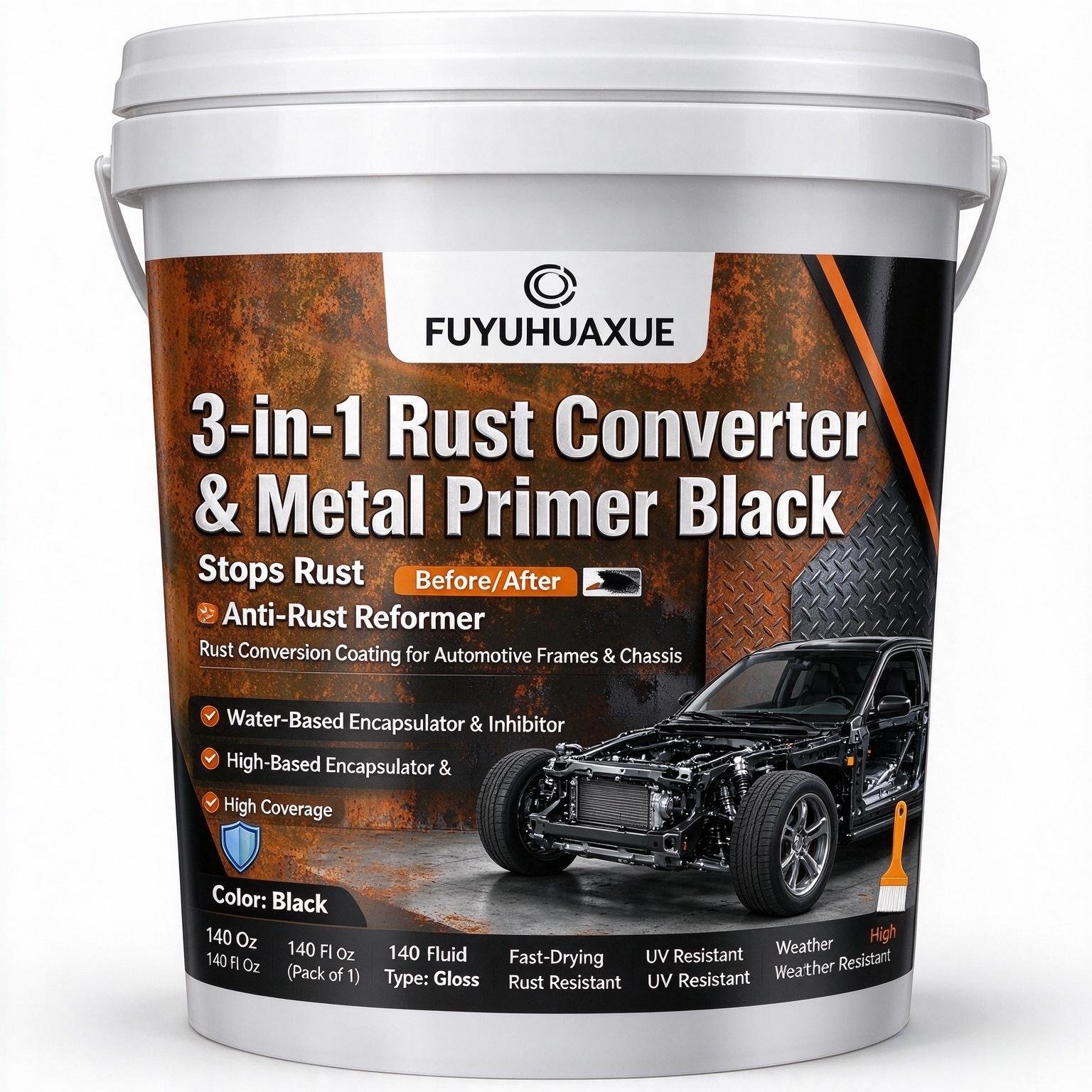
That is precisely what FUYUHUAXUE 3-in-1 Rust Converter & Metal Primer was engineered to do. Supplied in a substantial 140-fluid-ounce container in a gloss black finish, this is not simply a rust-colored paint or a hopeful barrier coat. It is a water-based rust conversion coating, an encapsulator, and an inhibitor—combined in a single ready-to-use formula that reacts with existing corrosion and stabilizes it into a durable, weather-resistant black surface.
For automotive frames and chassis, for trailers and RVs, for gates, railings, farm equipment, and every rusted metal surface that has been waiting for a solution that actually works, this is a genuinely different proposition.
The Chemistry of Conversion: What “Reforming” Rust Actually Means
To understand why a rust converter is different from a rust preventative, you have to understand what rust is.
Rust is not simply “dirty metal.” It is a new material—iron oxide, formed when iron reacts with oxygen and water. It is voluminous, porous, and non-structural. It occupies more space than the iron it came from, which is why rusted metal flakes, blisters, and eventually disintegrates. Crucially, rust is also hygroscopic: it holds moisture against the underlying steel, which is why corrosion accelerates once it begins. Painting over loose rust simply traps that moisture and hides the ongoing destruction.
A rust converter works differently. Its active chemistry—typically based on tannic acid or phosphoric acid compounds—reacts chemically with the iron oxide, converting it into a stable, inert compound (often iron tannate or iron phosphate). The rust is not removed; it is transformed. The resulting layer is hard, adherent, and non-reactive—a sound substrate for a protective coating rather than a spongy reservoir of moisture.
FUYUHUAXUE’s 3-in-1 formula is described precisely in its technical literature: it reacts with existing rust to help stabilize the surface while forming a durable black coating that helps protect metal against moisture, oxidation, and corrosion.
This dual action—chemical stabilization plus physical encapsulation—is the core of the product’s value. The conversion chemistry neutralizes the active corrosion; the black coating seals the stabilized surface against the moisture and oxygen that would otherwise restart the cycle. And because the coating is applied directly to properly prepared rusted metal, it eliminates the need for complete mechanical rust removal—the single most labor-intensive and least reliable step in traditional rust repair.
Three Products in One: Converter, Primer, Inhibitor
The “3-in-1” designation is not a marketing flourish. Each of the three functions addresses a distinct failure mode, and each would ordinarily require a separate product and a separate application step.
Function One: The Converter. As described above, the formula reacts with existing rust to stabilize it. This is what allows the product to be applied directly over rusted surfaces rather than requiring a bare-metal substrate. It is the reason the product can save hours of grinding and wire-brushing—and, importantly, the reason it can treat the pitted, inaccessible areas that mechanical preparation always misses.
Function Two: The Primer. A primer’s job is to provide adhesion and a uniform base for subsequent coatings. FUYUHUAXUE’s formula delivers strong adhesion and high coverage, and is explicitly designed for iron, steel, aluminum, and other properly prepared metal surfaces. It helps hide old colors, stains, and surface imperfections, and it resists peeling, blistering, and chipping. In practical terms, this means the converted surface is not merely stabilized—it is finished. For many applications, the black gloss coat is the final finish.
Function Three: The Inhibitor. An inhibitor’s job is to prevent new corrosion from starting. The durable black coating seals the metal against moisture, oxidation, and corrosion, providing ongoing protection rather than a one-time chemical treatment. This is what distinguishes a true rust treatment system from a conversion wash that stabilizes rust but leaves the surface unprotected and vulnerable to immediate re-oxidation.
Together, the three functions produce a cost-effective solution that replaces a multi-product, multi-step process with a single can and a single application—followed, for best results, by a second coat.
Durability That Stands Up to Weather, Sun, and Time
The specification sheet for this product reads like a checklist of everything that usually goes wrong with rust repair coatings.
Fade resistant. Black coatings are notorious for chalking and fading under UV exposure, turning gray and powdery within a season. A fade-resistant formulation maintains its appearance—important for visible surfaces like gates, railings, and furniture.
UV resistant. Ultraviolet light degrades many protective coatings, breaking down the polymer matrix and opening the door to moisture ingress. UV resistance is what allows the product to be used outdoors with confidence.
Weather resistant. Heat, sunlight, moisture, and changing weather conditions are the everyday assault faced by any exterior metal surface. The product is built for demanding indoor and outdoor projects and provides durable protection against routine environmental exposure.
Fast-drying. Time is money in any maintenance operation, and a fast-drying coating allows multiple coats to be applied in a single session, equipment to be returned to service sooner, and work to proceed without long curing delays.
Peeling, blistering, and chipping resistance. These are the three classic failure modes of coatings applied over poorly prepared or unstable substrates. Strong adhesion to the converted surface is what prevents them—and it is why the conversion step matters so much. A coating applied over loose, unconverted rust will fail; a coating applied over chemically stabilized rust has a sound foundation.
High coverage. With 140 fluid ounces in the container, the product is formulated to cover substantial surface area—appropriate for large jobs like chassis, frames, trailers, and fencing, where a small container would be exhausted before the work is half done.
The result, as the specification puts it, is a smooth, durable finish that offers a cost-effective solution for rust treatment and ongoing metal protection.
Low Odor, Water-Based: A Practical Advantage Indoors
One of the most underappreciated features of this product is its low-odor, water-based formulation.
Traditional rust conversion products and metal paints are frequently solvent-based, producing strong fumes that make indoor application uncomfortable and, in poorly ventilated spaces, genuinely hazardous. A water-based formula changes the practical reality of the job. It is more comfortable to use for indoor applications with proper ventilation, and it reduces the burden of respiratory protection and air handling.
Consider where rust repair actually happens. It happens in garages. In workshops. In basements. In barns and sheds with the doors closed against the weather. In these settings, a low-odor product is not a luxury—it is what makes the work possible in the first place, and what makes it possible to do safely.
Simple Application: No Skills Required
The most common reason rust repair is deferred is not cost—it is intimidation. The perception is that proper rust treatment requires specialized skill, specialized equipment, and a level of surface preparation that most people cannot realistically achieve.
FUYUHUAXUE’s formulation is explicitly designed to remove that barrier. The product is ready to use and comes with gloves and a brush, meaning the user can begin work immediately without sourcing additional supplies. The stated application method is refreshingly direct: remove loose rust, dirt, grease, and other contaminants, then brush onto the prepared surface. No skills are required. The black coating applies evenly for consistent coverage, and two coats are recommended for best results.
That last point deserves emphasis. The two-coat recommendation is not an upsell—it reflects the reality that a second coat improves film build, coverage uniformity, and barrier performance. Since the product dries fast, two coats can typically be completed in a single working session.
The key preparation step is worth repeating: remove loose rust. The product is a converter, not a miracle. It stabilizes sound, adherent rust; it cannot bind loose, flaking scale into a structural film. Removing the loose material—by wire brush, scraper, or wire wheel—takes a fraction of the time required for full rust removal, and it is the single step that most determines the success of the finished job.
Versatility Across Every Metal Surface That Matters
The specification lists an unusually broad range of applications, and they reflect the genuine versatility of a product designed for both restoration and routine maintenance.
Automotive frames and chassis. This is the flagship application, and for good reason. Frames and chassis are structurally critical, frequently rusted, and difficult to prepare fully—accessible in some places, inaccessible in others. A converter that can be brushed onto prepared rust and left as a durable black protective finish is ideally suited to the geometry of a vehicle underside.
Cars, trucks, trailers, and RVs. Beyond frames, the product serves on suspension components, wheel wells, hitches, tongue jacks, bumper brackets, and trailer beds—all of which live in the splash zone and all of which are expensive to replace.
Garage doors, gates, fences, and railings. These are the visible metal surfaces of a property, and they are exposed to weather year-round. Rust on a gate is both a structural and an aesthetic problem; a gloss black conversion coating addresses both at once, refreshing worn metal and providing a durable protective finish.
Farm equipment. Implements, augers, plows, and trailers face soil moisture, fertilizer salts, and manure acids—an aggressive combination that attacks welds, edges, and thin sections first. A converter applied to prepared rusted areas stops the progression and provides a protective coat.
Furniture and tools. Outdoor furniture, workbenches, toolboxes, vise jaws, and hand tools all benefit from a durable black finish that resists rust and regular handling. Restoring a rusted piece of metal furniture to a clean gloss black finish is one of the most satisfying uses of a product like this—and one of the fastest.
Routine metal maintenance and DIY repair. The framing of the product as “practical for DIY repairs, restoration, and routine metal maintenance” captures its real utility: it lowers the barrier to doing something about rust, which means rust gets addressed early rather than deferred until it becomes structural.
The Economics of Conversion
Rust repair is expensive because rust is usually discovered late. By the time corrosion is visible enough to motivate action, the traditional response—grind, prime, paint—is labor-intensive, and in severe cases the affected component must simply be replaced.
Conversion changes the economics in three ways.
First, it reduces labor. Removing loose rust takes a fraction of the time required to remove all rust, and the conversion chemistry handles the pits and pores that mechanical preparation cannot reach.
Second, it consolidates products and steps. One can replaces a converter, a primer, and a protective coating. One application session replaces three, each with its own drying or curing interval.
Third, it extends asset life. A chassis, frame, gate, or implement that would otherwise continue corroding can be stabilized and protected—deferring or eliminating replacement cost entirely. For older vehicles, equipment, and structures where full restoration is not economically justified, this is often the difference between continued service and the scrap pile.
Set against the cost of replacement metal, professional labor, or a single structural failure, a 140-fluid-ounce container of conversion coating is an exceptionally modest investment.
Conclusion: Change the Question
The old question was: how do I remove all the rust? It was a question that produced endless labor, frequent disappointment, and a great deal of deferred maintenance.
The better question is: how do I stop the rust I already have, and protect the metal going forward?
FUYUHUAXUE’s 3-in-1 Rust Converter & Metal Primer answers that question with a single, water-based, low-odor formula that converts existing corrosion into a stable substrate, primes the surface for adhesion, and seals it under a durable, gloss black, weather-resistant coating—fast-drying, UV resistant, fade resistant, and ready to apply with the gloves and brush included in the container.
Three functions. One can. No specialist skills required.
Stop fighting rust. Convert it. FUYUHUAXUE 3-in-1 Rust Converter & Metal Primer—the black finish that begins where the corrosion ends.