
 By fuyuhuaxue@iumrs.com
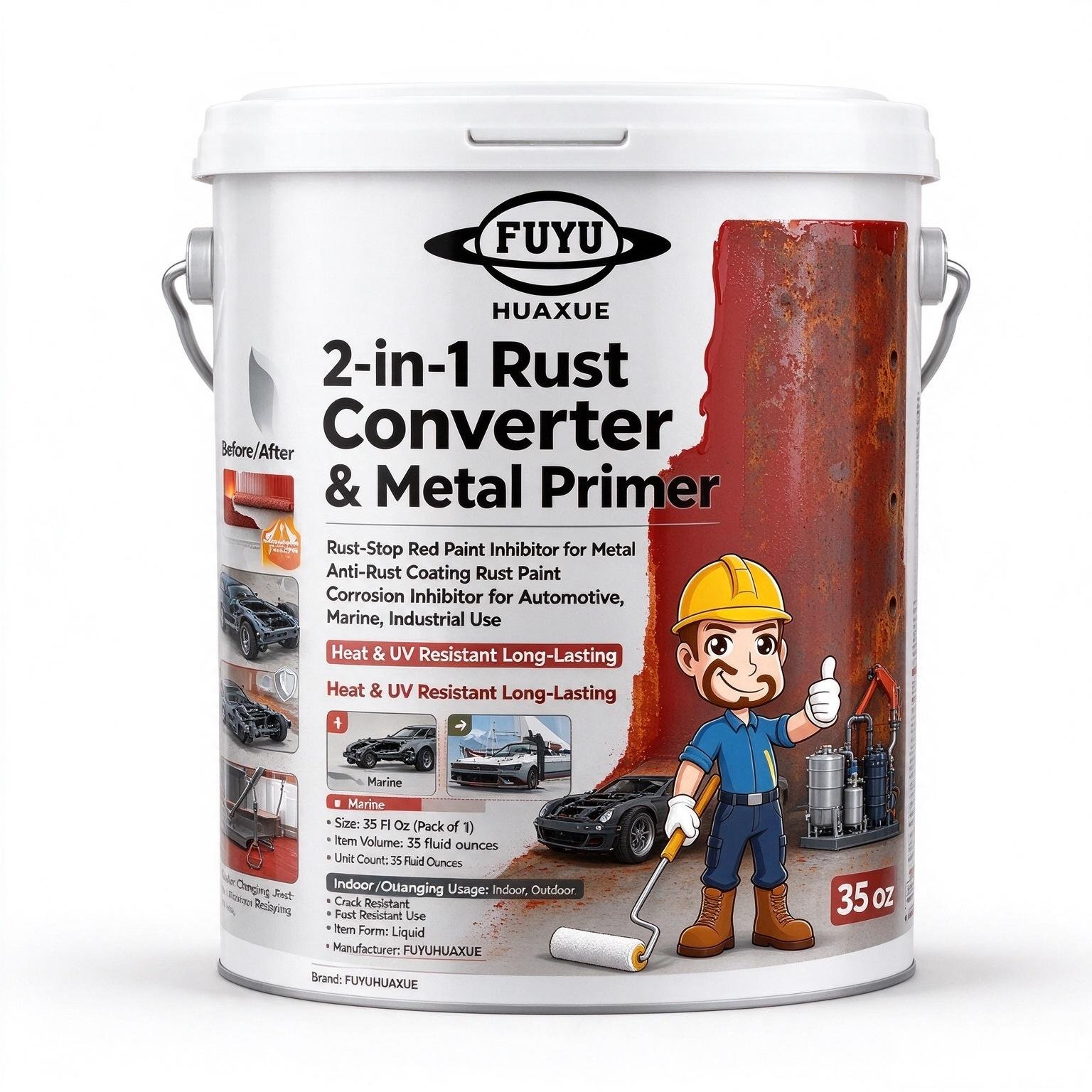
Every industry develops its own visual language. In corrosion protection, that language has always been red.
Red oxide primer is the color of preparedness—the unmistakable signal of a surface that has been treated, primed, and made ready for whatever comes next. It is the color that says this metal has been dealt with. It is the color of structural steel before the finish coat, of machinery frames in the maintenance bay, of the underside of a vehicle that someone cared enough to protect properly.
So when FUYUHUAXUE’s 2-in-1 Rust Converter & Metal Primer arrives in a 35-fluid-ounce container with a red finish and the designation Rust-Stop, it is speaking in a language that anyone who has ever maintained metal already understands. Red means stop. Red means treated. Red means the corrosion cycle has been interrupted.
But the color is not the whole story—and in this formulation, it is not even the most interesting part. This is a color-changing, crack-resistant, fast-drying, rust-resistant liquid that chemically transforms rust into a stable surface, bonds tightly to rusted or bare metal, and blocks out the moisture, air, and chemicals that cause future corrosion. It is a converter and a primer in one step, with no need to sand down to bare metal—and it is specified for indoor and outdoor use on steel, iron, aluminum, and other metals across automotive, farm, industrial, commercial marine, and construction applications.
For anyone who has looked at a rusted surface and wondered where to begin, the answer is now simply: apply, and protect.
Stops Rust and Seals in One Step
The core proposition is stated with unusual clarity in the product’s own description: our Ultimate Rust Converter chemically transforms rust into a stable surface while doubling as a Rust Converter & Metal Primer.
Two mechanisms are at work in that single sentence, and both matter.
The transformation. Rust is not merely discolored metal. It is iron oxide—porous, voluminous, and chemically active against the steel beneath it. Left alone, it retains moisture and continues to consume the metal from within. A converter reacts with that oxide and transforms it into a stable, inert compound that bonds tightly to the substrate. The active corrosion is neutralized. What was an ongoing reaction becomes a sound foundation.
The bond. The product bonds tightly to rusted or bare metal—which is precisely what a protective coating must do. Adhesion is the property on which every other performance claim depends. A coating that does not bond will not protect, regardless of how impressive its other specifications may be. The bond is what allows the film to block out moisture, air, and chemicals, and thereby prevent future corrosion.
The practical consequence is stated directly: No need to sand down to bare metal—simply apply and protect. This is the sentence that changes the economics of rust treatment. Sanding to bare metal is the most labor-intensive, most time-consuming, and least reliable step in conventional rust repair. It is also frequently impossible—in pits, welds, seams, and box sections that no abrasive can reach. A product that stabilizes sound rust and bonds to it eliminates that step without sacrificing protection.
The specification frames the outcome as perfect for prepping surfaces for painting or sealing—which is the correct way to understand the product’s role. It is not merely a final coat. It is the foundation that makes a final coat possible.
Color Changing: The Visual Indicator That Removes the Guesswork
Among the product’s special features, Color Changing is the one that most directly improves the user experience.
Rust conversion is an invisible chemical reaction. The user cannot see the moment the oxide has been transformed, cannot see whether coverage is complete, and cannot see where the film is too thin. This uncertainty is one of the reasons rust treatment is so often done badly—the applicator has no visual feedback to work from.
A color-changing formulation provides that feedback. As the product reacts with the rusted surface and cures, its appearance shifts—giving the user a visible signal that the chemistry has engaged and the coating is progressing through its cure. This transforms a blind process into an observable one. It is, in effect, a built-in quality check, and it is particularly valuable for DIY users who have never done rust treatment before and for professionals who are working in low-light conditions under a vehicle or inside a structure.
Combined with the red finish, the visual language becomes complete: the coating tells you where it is, what it is doing, and whether it has finished.
The Chemistry of Cure: Fast-Drying, Moisture-Cured, Hammer-Tough
The curing mechanism of this product is where its most distinctive performance claims originate—and it is worth understanding, because it explains why the finish behaves the way it does.
The specification states that the secret strength lies in the curing process. Most paints dry through evaporation: a solvent or water carrier leaves the film, and what remains is the coating. Moisture-cured chemistry works differently. The curing reaction is driven by reaction with moisture—ambient humidity, water vapor, and moisture present on or near the substrate. The practical result is that the coating dries faster when moisture is present.
Consider what this means in the environments where rust actually occurs. Rust happens in damp basements, in coastal air, in rainy seasons, in humid garages, and on surfaces that are rarely fully dry. These are precisely the conditions that slow or compromise conventional coatings—and precisely the conditions in which this product accelerates.
Once cured, the specification describes the result in terms that are deliberately concrete: the coating forms an indestructible, hammer tough finish, locks out water and air, preventing oxidation and protects metal surfaces from corrosion and moisture.
Hammer tough is not a casual phrase. It describes a film that resists impact—that does not chip, crack, or shatter when struck. This matters enormously in real service. Underbody components take gravel strikes. Machinery frames take tool contact. Structural steel takes handling and abrasion. A film that fails under impact becomes a film with breaches, and breaches are where corrosion begins. A hammer-tough film maintains its barrier integrity under the abuse that equipment actually experiences.
The crack-resistant feature listed in the specification is the corollary. Cracks are the entry points for moisture and oxygen; a crack-resistant film preserves the continuity of the barrier through thermal cycling, mechanical flexing, and physical impact.
Heat Resistant to 350°F: Engine Bays, Brakes, and Beyond
The product is specified as heat resistant up to 350 degrees Fahrenheit and can be safely used in the engine compartment or near brakes.
This is a meaningful qualification. Engine compartments and brake assemblies are among the most demanding locations on any vehicle—not merely because of the heat, but because heat compounds every other degradation mechanism. Coatings that perform well at ambient temperature can blister, chalk, or lose adhesion when cycled repeatedly to elevated temperatures. A coating rated to 350°F maintains its bond and its barrier under those conditions.
The practical applications follow directly:
Engine compartments. Brackets, valve covers, engine mounts, accessory brackets, and structural components that operate in heat and oil vapor.
Brake components. Calipers, backing plates, and adjacent hardware that cycle between high temperature under braking and ambient cooling.
Exhaust-adjacent metal. Hangers, shields, and mounting hardware where radiated heat is a constant condition.
Machinery housings. Equipment that operates at elevated temperatures in industrial and agricultural settings.
For automotive, farm, industrial, marine, and construction uses—the five industries the specification names—the heat rating expands the product’s reach well beyond ambient-condition surfaces.
For Every Metal Surface—and Every Porous One
The product is specified for steel, iron, aluminum, and other metals, and is used across automotive, farm, industrial, commercial marine, and construction industries.
But the specification includes a detail that is genuinely unusual and genuinely useful: our coating has excellent surface tolerance on porous surfaces, such as wood, fiberglass, concrete, bricks, and more.
This is significant because real-world structures are rarely made of one material. A trailer has a steel frame and a wooden deck. A gate hangs from concrete posts. A structural assembly combines steel members with fiberglass panels or brickwork. Most rust-preventive coatings are formulated exclusively for metal and perform poorly on absorbent substrates—they lift, blister, or fail to bond.
A coating with excellent tolerance on porous surfaces solves several practical problems at once:
Transition zones are protected. Corrosion frequently concentrates where metal meets concrete or wood—at the base of a railing post, at a mounting bracket, at a structural joint. A coating that adheres to both materials protects the transition, which is often the first point of failure.
Mixed-material assemblies get one system. A single product simplifies the job and produces a more consistent protective envelope.
Inventory is simplified. For contractors and maintenance teams, one coating that works across metal, wood, fiberglass, concrete, and brick reduces the number of products that must be stocked and specified.
Easy to Use: The Application Procedure That Produces the Result
The specification provides a precise application procedure, and following it is the difference between achieving the product’s performance and merely applying a coating.
Prepare. Remove grease, oil, and other foreign substances. Contaminants prevent adhesion, and adhesion is the foundation of everything the product does.
Stir thoroughly—do not shake. This instruction is precise and important. Stirring incorporates the components uniformly without introducing air. Shaking aerates the product, and entrapped air becomes porosity in the cured film—the one defect a protective barrier cannot tolerate.
Apply thin coats, minimum of two. Thin films dry uniformly, adhere reliably, and build a consistent barrier. The specification is explicit that at least two coats are required for best results.
Recoat when dry to the touch—typically 2 to 5 hours. This generous window allows multiple coats to be completed within a single working session while ensuring each coat has cured sufficiently before the next is applied.
Application method. The product is rather thick and can be directly applied by brushing or rolling. For spraying, dilute it appropriately as needed. The ratio of paint to thinner is approximately 1:0.2. This is practical, actionable guidance—thick enough to brush into seams and welds, and adjustable for spray equipment when large areas are being covered.
The procedure is simple enough for a first-time user to follow and specific enough for a professional to rely on. No professional skills are required; no specialized equipment is mandated beyond a brush, roller, or sprayer.
The Satisfaction Commitment
One final element of the specification deserves attention, because it is the kind of commitment that says something about the manufacturer: FUYUHUAXUE’s satisfaction commitment.
The company states that it strives to bring the ultimate in rust prevention, is committed to innovation, quality control, and excellent customer service, and that its patient service team will serve wholeheartedly, solving your misgiving—including resupply of a flawless product or making up all value of your order.
For a product that will be applied to expensive equipment, that commitment matters. It signals that the manufacturer stands behind the chemistry—and that if something goes wrong, the customer is not left holding a failed coating and a rusted component.
Conclusion: Red Means Stop
Rust is a process, not a condition. It does not stop on its own, and it does not stop because a surface has been painted over. It stops when the chemistry that drives it has been neutralized and the environment that sustains it has been excluded.
FUYUHUAXUE’s 2-in-1 Rust Converter & Metal Primer does both in a single step. A color-changing, crack-resistant, fast-drying formulation that transforms rust into a stable surface, bonds tightly to rusted or bare metal, cures faster in the presence of moisture, and forms a hammer-tough, heat-resistant film that locks out water and air. No sanding to bare metal. Two thin coats. Recoat in two to five hours. Stir, don’t shake. Dilute 1:0.2 for spraying.
For steel, iron, aluminum, and porous surfaces alike—automotive, farm, industrial, commercial marine, and construction.
FUYUHUAXUE Rust-Stop. Red is not a warning. It is the color of rust that has been stopped.