
 By fuyuhuaxue@iumrs.com
There is a particular kind of corrosion that only reveals itself when it is already too late. It does not start on the flat, visible surfaces where a brush or a spray can easily reach. It begins in the seams. It begins behind the spot welds. It begins inside the box sections of a chassis, in the lap joints of a trailer frame, and in the crevices where two pieces of steel meet and where moisture, salt, and oxygen quietly take up permanent residence.
Anyone who has maintained equipment in a marine environment or driven a vehicle through a northern winter understands this intimately. You can coat every surface you can see, and still watch rust bloom from the inside out—pushing through paint from behind, staining the underside of a truck bed, or quietly consuming the structural steel of a boat trailer while the exterior looks perfectly sound.
The reason is simple physics. Corrosion is a capillary phenomenon as much as a chemical one. Salts and brines do not stay where they land; they wick into narrow gaps, drawn by surface tension into spaces far too tight for conventional coatings to follow. A paint film sits on the surface. A grease sits on the surface. But the salt water gets in underneath, behind, and between—and once it is there, it stays.
Solving this problem requires a different approach. It requires a product that does not simply sit on top of metal, but actively migrates into the places where corrosion starts.
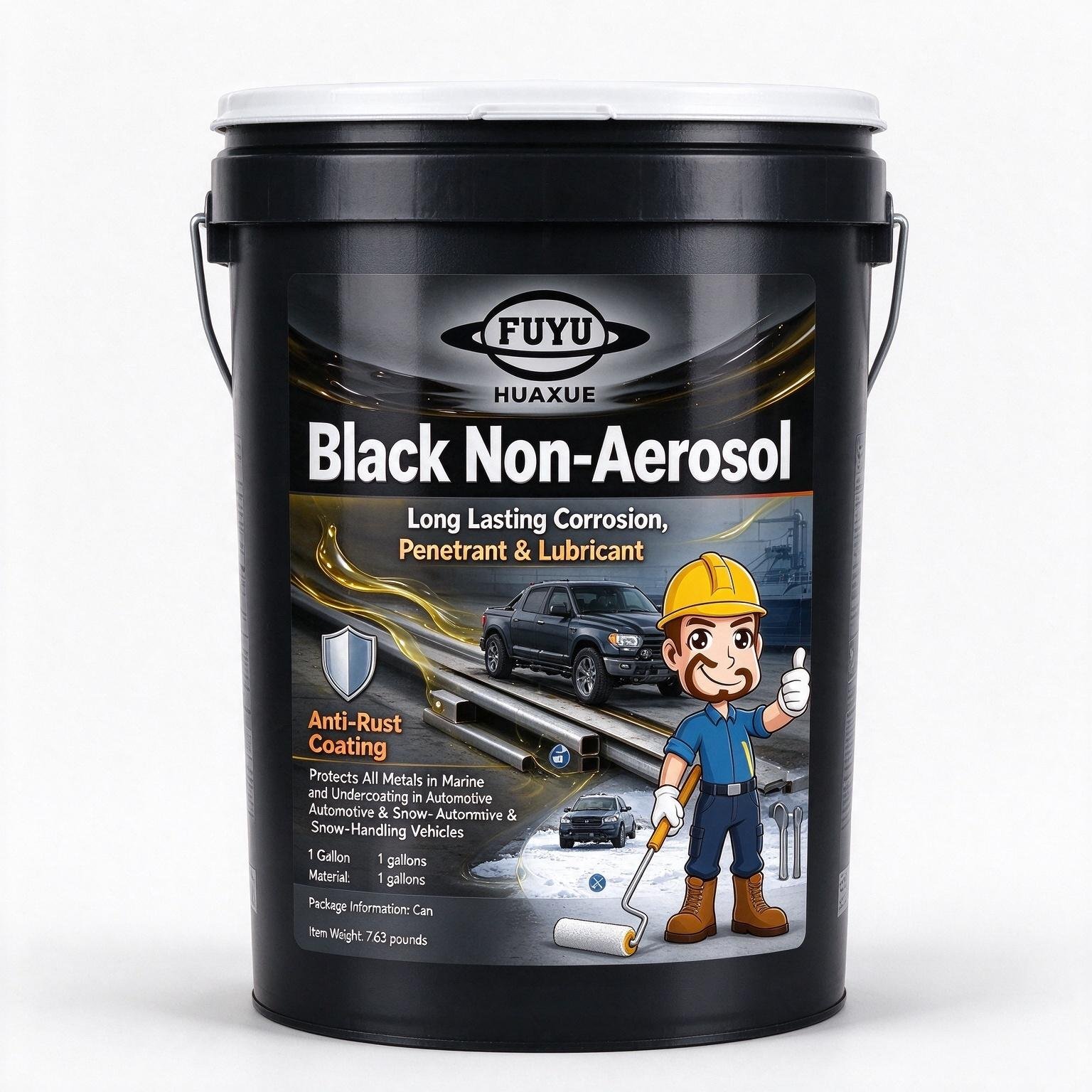
That is exactly what FUYUHUAXUE’s Black Non-Aerosol Long-Lasting Corrosion, Penetrant & Lubricant is engineered to do. Supplied in a 1-gallon plastic can (7.63 pounds), this is a solvent-free, thixotropic wet-barrier coating built on specially processed wool-wax and highly refined petroleum oils—a formulation designed for the most punishing corrosive environments on earth: the marine industry, automotive undercoating, and the salt-and-brine assault of snow-handling vehicles.
The Creeping Wet Barrier: How It Actually Works
The defining characteristic of this product is described in its own technical literature with unusual precision: the wet barrier creeps and migrates into tight seams and into the metal chassis to provide corrosion protection from salts and brines.
This is the mechanism that separates it from ordinary undercoats and rust paints. The product is a thixotropic liquid—meaning it has a gel-like consistency that resists running and dripping, yet flows readily when agitated or applied under pressure. This dual nature is essential. A thin oil would run off vertical surfaces and provide no lasting barrier. A thick paste would never penetrate a seam. A thixotropic formulation does both: it creeps into capillaries under the influence of surface tension and capillary action, then holds its position once it has migrated.
The result is a wet barrier—not a hard, dry film, but a persistent, self-healing coating that remains active and mobile over time. This has several important consequences:
It reaches what brushes cannot. Applied to a chassis rail, a door cavity, or a welded seam, the product wicks into the joint and coats the interior surfaces where salt water accumulates.
It displaces water. Because it is formulated for water displacement as part of its core function, the product pushes moisture off the metal surface rather than trapping it beneath the coating—a critical distinction from many undercoats that seal moisture in and accelerate corrosion from within.
It stays put. The thixotropic body resists wash-off from rain, spray, and road splash, providing long-lasting protection in exposed locations.
It lubricates as it protects. This is not purely a coating. It is explicitly a penetrant and lubricant as well, which means it serves double duty on moving parts, hinges, linkages, cables, and threaded assemblies.
No Solvent: The Chemistry of Wool-Wax and Refined Petroleum Oils
The second defining feature of this product is what it does not contain: solvent.
This is a meaningful claim in an industry where most rust preventatives, undercoats, and penetrants are solvent-borne. Solvents serve a purpose—they thin the product for spray application and evaporate quickly—but they also introduce real drawbacks. They are flammable. They produce volatile organic compounds. They can attack existing paint, rubber, and plastic components. They dry out seals. And in a confined space, they create a genuine health and safety hazard for the person applying the product.
FUYUHUAXUE’s formulation avoids these problems entirely. It is built from specially processed wool-wax, highly refined petroleum oils, and selected agents. The result is a coating that is:
- Non-toxic
- Non-irritating
- Non-flammable
For professional applicators working under a vehicle, inside a hull, in a maintenance bay, or in a warehouse, these properties matter enormously. There is no flashpoint concern, no solvent vapor to ventilate, no need for respiratory protection beyond normal good practice, and no risk of the product igniting near welding or grinding operations. For facilities with strict environmental and worker-safety requirements—government depots, commercial fleets, food-adjacent equipment maintenance, aviation hangars—a non-flammable, non-toxic formulation simplifies compliance considerably.
Wool-wax (lanolin) chemistry is well established in corrosion protection for good reason. It is naturally hydrophobic, adheres tenaciously to metal, and remains soft and mobile rather than becoming brittle. Combined with refined petroleum oils, it forms a barrier that is simultaneously durable and self-renewing—one that continues to creep and protect rather than failing once it is disturbed.
Built for the Marine Environment
Of all the corrosive environments on earth, the marine environment is the most demanding. Salt water is an electrolyte of extraordinary aggressiveness. Salt spray carries that electrolyte onto every exposed surface. Humidity keeps it active. UV degrades many coatings. And the consequences of failure—on a boat trailer, a winch, a steering assembly, a dock fitting—are not merely cosmetic.
This product is explicitly designed for the highly corrosive marine environment, and its properties map directly onto marine maintenance realities:
Trailers and launching gear. Boat trailers live the worst possible life: submerged in salt water at the launch ramp, then towed at highway speed where spray atomizes into every crevice, then parked in the open air. The box sections of a trailer frame are notorious for internal rust that is invisible until structural failure. A creeping wet barrier applied to those sections migrates into the interior and holds the salt at bay.
Winches, windlasses, and deck hardware. These are moving assemblies that need both protection and lubrication—precisely the dual function this product provides. It penetrates into cables, gears, and pivot points, displacing water and leaving a persistent protective film.
Engine compartments and electrical connections. Water displacement is critical here. The product’s ability to migrate into connectors and coat terminals helps suppress corrosion that would otherwise cause intermittent electrical faults.
Anchors, chain, and ground tackle. Stored wet, used in abrasive conditions, and frequently neglected—chain and anchors benefit enormously from a coating that creeps into links and resists wash-off.
For anyone maintaining equipment in a salt-heavy environment, the logic is straightforward: you cannot inspect what you cannot see, and you cannot coat what you cannot reach. A creeping barrier solves both problems at once.
Automotive Undercoating and the Snow-Belt Problem
If the marine environment is the most aggressive, the winter road environment is the most deceptive. Modern road authorities do not simply spread salt; they spread brine—a liquid salt solution that is sprayed onto roads before, during, and after storms. Brine is far more insidious than rock salt because it flows. It gets into every seam, every cavity, every electrical connector, and every box section of a chassis. It dries, re-crystallizes, and reactivates with the next thaw.
This is why vehicles in snow-handling regions corrode from the inside out—and why brake lines, fuel lines, subframes, and rocker panels fail long before the visible bodywork shows serious damage.
The product’s specified application in vehicle undercoating in the automotive and snow-handling industries addresses this directly.
Chassis and underbody protection. Applied to frame rails, crossmembers, floor pans, and wheel arches, the thixotropic barrier creeps into seams and welds, coating surfaces that conventional undercoat spray cannot reach.
Cavity protection. Rocker panels, doors, quarter panels, and cab corners are all vulnerable box sections. The creeping action is ideally suited to these internal cavities.
Restoration of black color. A practical and often overlooked benefit: the product restores a rich black color to the chassis. For restoration shops, fleet operators, and anyone presenting a vehicle for inspection or sale, a properly coated underbody looks as good as it is protected.
Covering existing rust. Importantly, the product covers existing rust—meaning it can be applied over surfaces that have already begun to corrode, encapsulating and slowing further oxidation rather than requiring full removal of all rust before application. For older vehicles and equipment where full restoration is not economically viable, this is a genuine, practical advantage.
Snow-handling vehicles specifically. Plow trucks, salt spreaders, brine tanks, and municipal winter equipment operate in a continuous bath of the most corrosive material on the road. These vehicles are expensive, are expected to last for decades, and are often stored outdoors. A solvent-free, non-flammable, creeping barrier applied to their chassis and spreading equipment is a direct investment in asset life.
Wide-Ranging Applications Beyond Vehicles and Boats
The specification sheet lists an unusually broad range of use cases, and they are not marketing padding—they reflect the fundamental versatility of a solvent-free penetrant, lubricant, and corrosion barrier.
Home maintenance: locks and hinges. The penetrant action frees stiff mechanisms; the lubricant keeps them moving; the barrier prevents re-seizure. Exterior door hinges, gate hardware, padlocks, and garage door mechanisms all benefit.
Lawn and garden tools and equipment. Mower decks, tiller tines, chipper blades, and hand tools are exposed to soil moisture and grass clippings—one of the most corrosive combinations in existence. A creeping coating protects welds and edges where corrosion concentrates.
Aviation industry. Aircraft and ground-support equipment operate in environments where corrosion control is a regulated, safety-critical concern. Water displacement and seam penetration are valuable properties in airframe and component maintenance.
Automobile industry. Beyond undercoating, the product serves in assembly, storage, and component preservation.
Government and commercial facilities. Depots, motor pools, and maintenance yards need products that are non-flammable, non-toxic, and effective across a wide range of equipment. A single 1-gallon can supports many applications, simplifying inventory.
Fishing industry. Nets, winches, davits, crab pots, and deck machinery all live in salt.
Gas companies. Pipeline fittings, valves, meter sets, and above-ground hardware require ongoing corrosion control in outdoor, sometimes coastal, environments.
Farming. Implements, trailers, grain augers, and livestock equipment face fertilizer salts, manure acids, and soil moisture.
Salt plants. Equipment in salt production and handling faces the highest salt loading imaginable.
Power and industrial plants. Structural steel, valve assemblies, flanges, and outdoor equipment require durable, low-maintenance protection.
Practical Format and Application
The product is supplied in a 1-gallon plastic can weighing 7.63 pounds—a format that reflects its professional orientation. A gallon is enough for substantial coverage on a vehicle underbody, a trailer frame, or a set of marine hardware, while remaining manageable for a single technician.
Application is straightforward. Surfaces should be cleaned of loose scale, mud, and heavy grease. The product can be applied by brush, roller, or spray equipment rated for viscous materials, and the thixotropic body allows it to be worked into seams and cavities deliberately. Because it is solvent-free and non-flammable, application does not require special ventilation or fire precautions. The wet barrier remains active after application, continuing to creep into adjacent seams over time.
The Economic Argument for a Creeping Barrier
Corrosion protection is almost always framed as a cost. It is more accurate to frame it as cost avoidance.
Consider the failure modes this product addresses. A trailer frame that rusts through from the inside requires replacement—often at a cost exceeding the value of the trailer. A plow truck subframe failure takes a municipal vehicle out of service in the middle of winter. A corroded electrical connector causes an intermittent fault that consumes hours of diagnostic labor. Brake and fuel line corrosion is a safety issue with no acceptable tolerance.
Against that, a gallon of creeping, solvent-free, non-flammable barrier is a trivial expense. It requires no special equipment, no special training, no special ventilation, and no regulatory burden. It can be applied in the field, in the shop, or in the yard, and it protects surfaces that no other product can even reach.
Conclusion: Protection That Goes Where the Problem Goes
Rust does not respect surfaces. It goes where the water goes—into seams, behind welds, inside cavities, and down the capillary spaces that every conventional coating leaves unprotected.
FUYUHUAXUE’s Black Non-Aerosol Corrosion, Penetrant & Lubricant was designed around that reality. A solvent-free, wool-wax-based, thixotropic wet barrier that creeps and migrates into tight seams, displaces water, lubricates moving parts, restores a rich black finish, and covers existing rust—non-toxic, non-irritating, and non-flammable.
For marine equipment, for winter-road vehicles, for plow trucks and salt spreaders, for trailers and chassis and every hard-to-reach piece of metal that matters, the answer is not more coating on the surface. The answer is a barrier that goes where the problem goes.
One gallon. No solvent. No shortcuts. FUYUHUAXUE—protection that creeps into every seam.