
 By fuyuhuaxue@iumrs.com
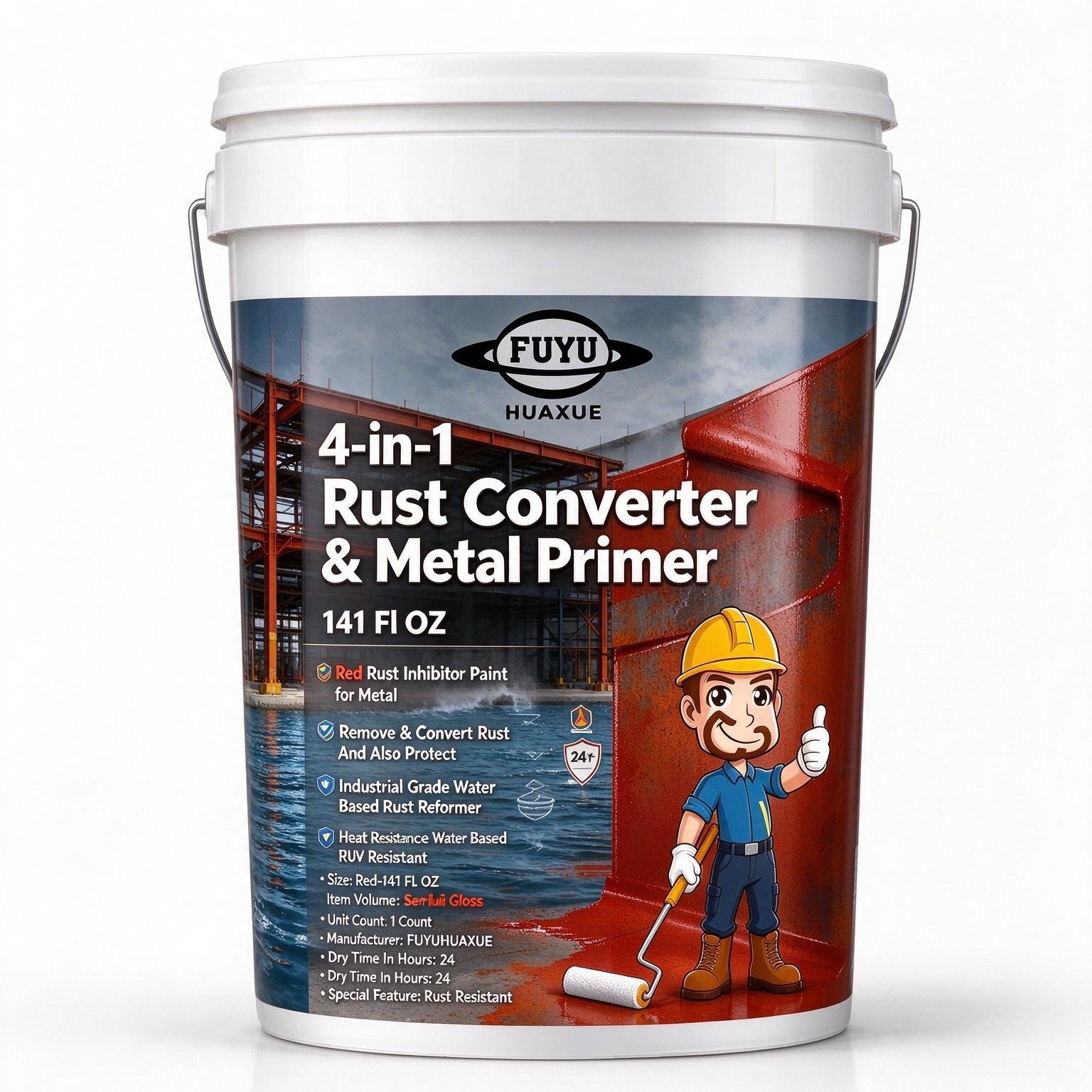
Rust protection has traditionally been sold as a sequence of separate jobs, performed by separate products, at separate times.
First, you remove the rust—by grinding, wire brushing, or blasting. Then you treat what remains—with a converter or a neutralizer, which is a different product with a different chemistry and a different cure time. Then you prime the surface, because the converter alone will not provide the adhesion or the film build that a topcoat requires. Then you protect the surface, because the primer alone will not exclude moisture, salt, and oxygen for long. Four jobs. Four products. Four application sessions. Four curing windows. Four opportunities for something to go wrong.
For professional maintenance operations, this sequence is expensive. For the individual restoring a trailer, a piece of machinery, or a set of structural steel, it is often the reason the job never gets finished at all. The rust gets stabilized and then abandoned; the primer goes on and then sits unprotected; or the whole project stalls after the first stage because the weekend is over and the next available dry day is three weeks away.
FUYUHUAXUE’s 4-in-1 Rust Converter & Metal Primer was formulated against exactly this problem. Supplied in a 141-fluid-ounce container with a semi-gloss red finish, this is an industrial-grade, water-based, one-component coating that combines rust removal support, rust conversion, priming, and protective sealing in a single ready-to-use product. It is designed to protect automotive, machinery, marine, industrial, and construction metal surfaces against water, salt, chemicals, corrosive contaminants, and everyday wear and tear—with heat resistance up to 350°F and UV resistance for sustained outdoor exposure.
Four jobs. One can. One system.
The 4-in-1 Concept: What Each Function Does
The “4-in-1” designation is not a marketing flourish. It describes four distinct functions that, in a conventional approach, would require four separate products.
Function One: Rust Removal Support. The specification begins with preparation: remove the rust, oil stains and foreign substances from the base surface. This is the necessary first step for any rust treatment, and the product is designed to work with that preparation rather than substitute for it. Removing loose, flaking rust and surface contamination is what allows the conversion chemistry to reach sound, adherent oxide—the substrate the product is designed to transform.
Function Two: Conversion. This is the chemical heart of the product. The specification describes the mechanism precisely: the coating turns rust into an inert coating. Rust—iron oxide—is chemically active against the steel beneath it and structurally weaker than the metal from which it formed. A converter reacts with that oxide and transforms it into a stable, inert compound that bonds tightly to the substrate. The active corrosion is neutralized. What was an ongoing electrochemical reaction becomes a sound foundation for the protective film.
Function Three: Priming. A primer provides adhesion and a uniform base for protection. In this product, the converted film is the primer—there is no separate stage, no separate product, and no interface between layers where adhesion typically fails. The specification frames the product as a rust converter and metal primer in a single system, which is what allows the whole operation to be reduced to a single application process.
Function Four: Protective Sealing. The final function is the one that determines how long the job lasts. The specification describes the result as a one-component, ready-to-use rust preventive coating with extreme sealing properties that protects metal from water, salt, chemicals, corrosive contaminants and everyday wear and tear. The cured film is the barrier—the physical separation between the metal and the environment that would otherwise attack it.
The four functions are chemically integrated. The conversion creates the substrate; the primer bonds to it; the seal excludes what would restart the corrosion. Because they are delivered in a single product, they happen in a single application process—which is precisely the point.
Superior Oxygen Isolation: Why the Mechanism Matters
The specification makes a claim that deserves close attention: superior oxygen isolation.
This is the correct way to describe what a rust preventive coating actually does. Corrosion requires three ingredients: metal, water (usually with dissolved electrolyte such as salt), and oxygen. Remove any one of the three and the electrochemical reaction that produces rust cannot proceed. Most protective coatings focus on excluding water; the best ones exclude both water and oxygen.
The mechanism is described exactly: the coating locks water and air out, so oxidation cannot occur. Oxidation is the chemical process by which iron loses electrons to oxygen—the fundamental reaction of rusting. By sealing the surface against both water and air, the coating interrupts the reaction at its source rather than merely slowing it.
The specification frames this as providing long-lasting protection for metal surfaces, and the framing is appropriate. A barrier that excludes both reactants does not merely delay corrosion—it prevents the conditions under which corrosion can begin. That is the difference between a coating that buys time and a coating that solves the problem.
Heat Resistance to 350°F and UV Resistance: Built for Real Service
Two performance ratings determine where this product can be used with confidence.
Heat resistance up to 350°F (176°C). This rating is what makes the product suitable for applications beyond ambient conditions—engine bays, exhaust-adjacent components, machinery housings, brake components, and industrial equipment that operates at elevated temperatures. Conventional paints and coatings blister, chalk, or fail at these temperatures; a coating rated to 350°F maintains its barrier and its adhesion.
UV resistance. Ultraviolet light is the silent killer of exterior coatings. It breaks down polymer chains, causing chalking, fading, and micro-cracking—and micro-cracks are the entry points through which moisture and oxygen reach the metal. UV resistance is what allows the coating to be used outdoors with confidence, on structures and equipment that will be exposed to sun for years.
Together, these ratings define the product’s service envelope: automotive, machinery, marine, industrial, and construction applications, indoors and outdoors, at ambient and elevated temperatures, in sun and weather. The specification describes this as the permanent and cost-effective solution for those industries, and the ratings support the claim.
Wide Application: Where the 4-in-1 System Belongs
The specification lists the industries served, and each reflects a real application profile.
Automotive. Frames, chassis, suspension components, brackets, and underbody metal exposed to road salt, gravel, and abrasion. The heat resistance rating supports use on engine-bay and brake-adjacent components, while the conversion chemistry handles the pitted, inaccessible rust that mechanical preparation always misses.
Machinery. Equipment frames, housings, guards, and structural components. Machinery is expensive, frequently stationary for long periods, and often exposed to process chemicals, humidity, and physical wear. A coating that converts existing rust and seals the surface against further attack extends service life and reduces maintenance cost.
Marine. Above-water and splash-zone metal on vessels, dock equipment, trailers, and marine structures. Salt spray and constant humidity are the defining conditions, and the oxygen-and-moisture-exclusion mechanism is directly relevant to them.
Industrial. Structural steel, equipment frames, pipe supports, and fixtures in facilities where chemical exposure, humidity, and abrasion are routine. The industrial-grade designation and the water-based, low-VOC formulation suit facilities with environmental and occupational health requirements.
Construction. Steel components, formwork hardware, site equipment, and structural connections. The product can be applied in the field, cures to a tough film, and is compatible with the mixed-material assemblies that construction work routinely involves.
Across all five industries, the value proposition is the same: a permanent, cost-effective solution that removes and converts existing rust, primes the surface, and seals it against future corrosion—in a single integrated system rather than a four-stage process.
Easy Application: The Detailed Procedure That Produces the Result
The specification provides a precise application procedure, and following it is the difference between achieving the product’s performance and merely applying a coating.
Step One: Prepare. Remove the rust, oil stains and foreign substances from the base surface. Loose rust, grease, oil, and contamination must go. A wire brush or scraper removes the loose oxide; degreasing addresses oil and fuel contamination. The surface must then be completely dry before coating—a requirement that reflects the water-based chemistry and the importance of adhesion.
Step Two: Apply the first coat. Use a brush to apply the converter evenly onto the surface. The specification frames brush application as the standard method, which suits the geometry of frames, chassis, machinery, and structural steel.
Step Three: Apply thin layers. The instruction is explicit: apply the coating in thin layers. Thin films dry uniformly, adhere reliably, and build a consistent barrier. A single heavy application traps moisture, dries unevenly, and creates the internal stresses that lead to blistering and peeling.
Step Four: Allow 24 hours between coats. After the first layer is applied, allow it to dry for 24 hours to form a protective film, then apply the next layer. This is a longer intercoat interval than many coatings require, and it reflects the water-based conversion chemistry—the film needs time to develop its full adhesion and barrier properties before the next coat is applied.
Step Five: Apply at least two layers. At least two layers should be applied. The second coat covers the microscopic discontinuities in the first and ensures a continuous, sealed barrier.
Step Six: Protect the freshly coated surface for seven days. The specification is unusually direct about this: after the project is completed, please avoid contact with water or being in a humid environment within 7 days to prevent rust from reappearing. This is a cure-protection window, not a product limitation. The film continues to develop its final properties during this period, and premature water exposure can compromise the barrier before it is fully formed. It is a practical instruction that anyone working with water-based conversion coatings should take seriously.
Step Seven: Observe weather constraints. Construction cannot be carried out on overcast and rainy days. Water-based conversion chemistry requires conditions in which the applied film can cure properly. Applying during rain or in saturated conditions introduces water before the film has formed—precisely the condition the seven-day protection window is designed to prevent.
Followed correctly, this procedure produces a semi-gloss red, tightly bonded, heat- and UV-resistant film that converts existing rust, primes the surface, and seals it against the environment.
Water-Based, Low VOC, and Easy Cleanup
The formulation chemistry is water-based with less than 1% VOCs, and the practical consequences are significant.
Tools clean up with water. The specification states it plainly: thanks to our water-based formula, your tools can be cleaned quickly with just water. Brushes, rollers, and application equipment clean up without solvents—no solvent to source, no hazardous waste to manage, no specialized cleanup supplies.
Safer for users and the environment. A low-VOC, water-based formulation reduces solvent exposure during application, lowers flammability, and reduces the environmental burden across the product’s lifecycle. For professional facilities with environmental and occupational health obligations, this simplifies compliance. For individuals working in a home workshop, it makes the product genuinely pleasant and safe to use.
Indoor application becomes practical. Rust treatment frequently happens in garages, workshops, and enclosed spaces. A low-VOC, water-based product produces minimal odor and no solvent vapor, which makes indoor application far more comfortable and far safer than solvent-borne alternatives.
Conclusion: Stop Buying Four Products to Do One Job
The conventional approach to rust treatment is a sequence of separate products, each addressing one part of the problem, each requiring its own application and its own curing window—and each introducing its own opportunity for the system to fail at the interface.
FUYUHUAXUE’s 4-in-1 Rust Converter & Metal Primer collapses that sequence into a single integrated system. Remove the loose rust and contamination. Brush on a thin coat. Allow 24 hours. Apply a second coat. Protect the surface for seven days. The result is an inert, converted substrate, primed and sealed beneath a semi-gloss red, heat-resistant to 350°F, UV-resistant, water-based, low-VOC barrier that locks out water and air so oxidation cannot occur.
For automotive, machinery, marine, industrial, and construction applications—where equipment is expensive, corrosion is relentless, and maintenance time is scarce—this is the permanent, cost-effective solution the specification promises.
FUYUHUAXUE 4-in-1 Rust Converter & Metal Primer. Remove it, convert it, prime it, seal it. Four jobs, one coat, 141 fluid ounces of industrial-grade protection.