
 By fuyuhuaxue@iumrs.com
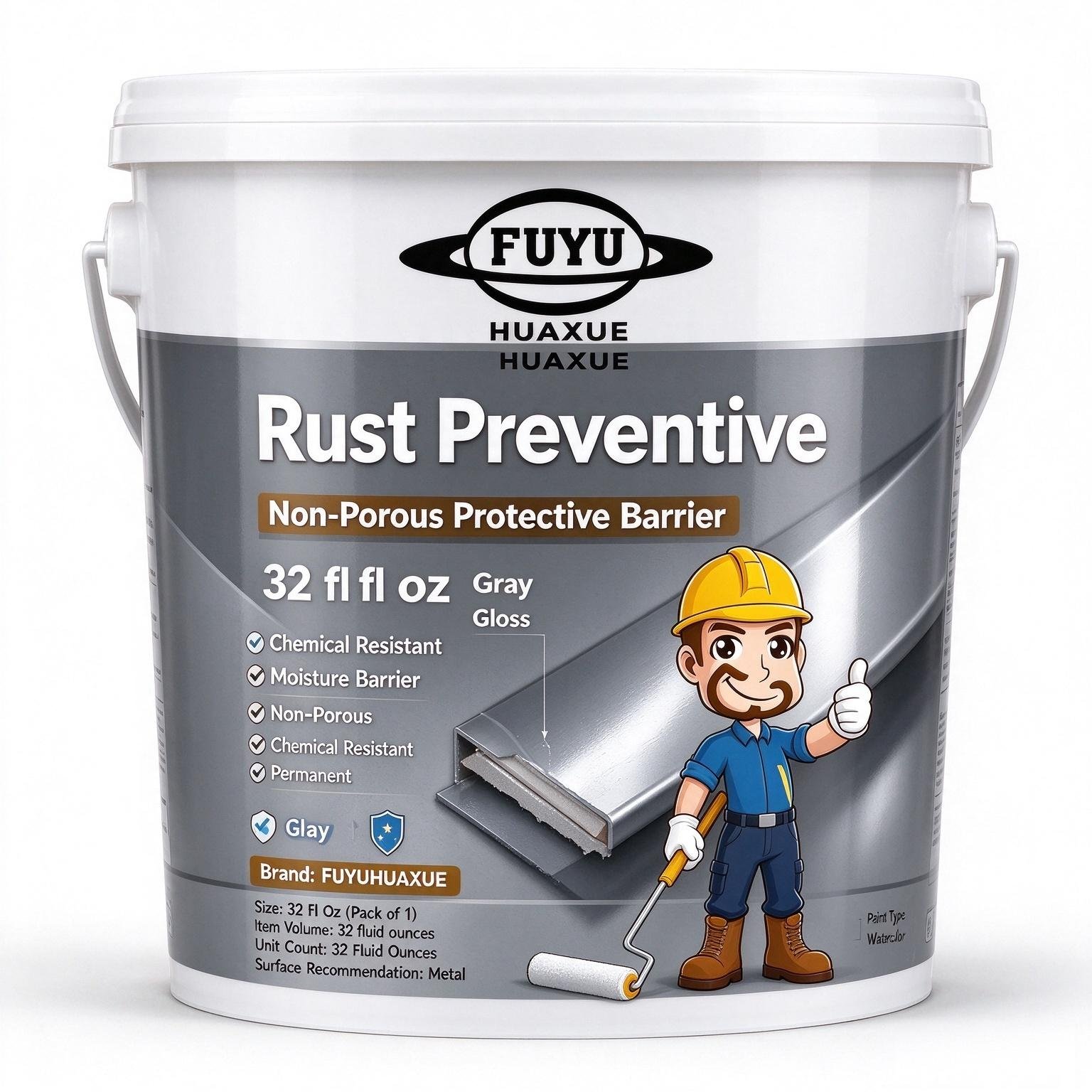
In corrosion engineering, there is a word that separates serious protective coatings from hopeful ones: non-porous.
It sounds technical, almost abstract. It is neither. A porous coating is a coating full of microscopic channels—paths through which water vapor, oxygen, salt ions, and chemical contaminants travel from the environment to the metal surface beneath. A porous coating may look continuous to the eye, but at the scale where corrosion actually happens, it is a sieve. Moisture enters, corrosion begins, and the coating that was supposed to protect the metal becomes a shelter under which the metal quietly dissolves.
A non-porous coating is different in kind, not merely in degree. It has no such channels. It is a continuous, sealed membrane that denies water, salt, and chemicals access to the metal surface. It is, in the most literal sense, a barrier—not a covering, not a film that slows corrosion down, but an actual physical separation between the metal and the environment that attacks it.
That distinction is the reason FUYUHUAXUE Rust Preventive Coating is worth serious attention. Supplied in a 32-fluid-ounce container with a gray gloss finish, this is a non-porous, moisture-cured protective coating formulated for interior and exterior use on metal—and specified for a performance standard that most consumer-grade rust coatings never approach: 168 hours of ASTM B117 salt spray exposure with no rust and no pitting.
That is a test result, not a marketing claim. And in the world of corrosion protection, test results are the only thing that ultimately matters.
168 Hours of Salt Spray: What the ASTM B117 Result Actually Means
ASTM B117 is the standard practice for operating salt spray (fog) apparatus. It is the most widely recognized accelerated corrosion test in the world, and it is brutal by design. Test panels are placed in a chamber where a continuous, atomized salt solution is sprayed onto them under controlled temperature and humidity. The environment is deliberately far more aggressive than most real-world service conditions—which is precisely the point. A coating that survives B117 is a coating with a genuine barrier.
168 hours is seven full days of continuous salt fog exposure. For context: many general-purpose rust paints begin to show red rust on scribed or unscribed panels within 24 to 72 hours. A result of 168 hours with no rust or pitting places this coating in a different performance class—one more commonly associated with industrial maintenance coatings and aerospace-grade protective systems.
What makes the result meaningful is the combination of outcomes. Red rust indicates that iron has been oxidized—that the barrier failed. Pitting indicates localized, deep corrosion—the most dangerous form, because it concentrates at points and can penetrate a metal section while the surrounding surface remains intact. A coating that resists both rust and pitting for seven days of continuous salt fog is demonstrating genuine barrier integrity, not merely a surface that resists discoloration.
For equipment that will be exposed to road salt, coastal spray, marine atmospheres, or industrial chemical environments, this result is the single most relevant performance number on the specification sheet.
Cured by Moisture: The Counterintuitive Chemistry That Makes It Work
The most distinctive feature of this coating is its curing mechanism: it dries faster when moisture is present.
This is counterintuitive to anyone familiar with conventional paints, which cure by solvent or water evaporation and are typically compromised by humidity during application. Moisture-cured chemistry operates on a different principle. The curing reaction is driven by reaction with ambient moisture—water vapor in the air, humidity, and even moisture present on or near the substrate. Instead of waiting for a carrier to evaporate, the coating reacts with moisture to crosslink into its final form.
The practical consequences are significant:
Faster curing in humid conditions. Where a conventional coating would be slowed or damaged by high humidity, this coating cures faster. Coastal environments, marine settings, rainy seasons, and humid climates—conditions that normally complicate coating work—are conditions in which this product performs well.
Cure in conditions where others fail. Damp basements, marine environments, and outdoor applications where dew or humidity is unavoidable are not obstacles to this coating; they are accelerants.
A hard, impact-tough finish. The specification is explicit: once cured, the coating forms a hard, impact-tough finish that resists chipping, cracking and peeling. These three failure modes—chipping, cracking, and peeling—are the mechanisms by which protective coatings most commonly die in service. A coating that resists all three maintains its barrier integrity under physical abuse, which is exactly what the barrier must do to remain non-porous.
A true barrier, once cured. Because the cured film is non-porous, it does not permit the moisture that helped cure it to penetrate afterward. The chemistry that uses water to cure is the same chemistry that denies water access once curing is complete.
Non-Porous: The Property on Which Everything Else Depends
The specification lists Non-Porous as a core special feature, and it deserves to be understood as the foundation of every other performance claim.
A non-porous coating excludes:
Water. Liquid water and water vapor cannot pass through a non-porous film. For metal stored or used outdoors, this is the fundamental requirement.
Chemicals. Industrial atmospheres, agricultural chemicals, cleaning agents, fuels, and solvents all attack metal. A non-porous barrier denies them access to the substrate.
Salt. Salt dissolved in water is the electrolyte that drives the corrosion reaction. A non-porous coating prevents the salt from reaching the metal, which is why the 168-hour salt spray result is achievable in the first place.
Corrosive contaminants. Atmospheric pollutants, acid deposition, and particulate contamination all contribute to corrosion. The non-porous barrier keeps them on the surface, where they can be washed away, rather than in contact with the metal.
Everyday wear and tear. The specification frames protection against water, chemicals, salt, corrosive contaminants and everyday wear and tear—the full spectrum of degradation mechanisms that equipment faces in normal service.
Non-porous is also why the moisture barrier and chemical resistant features are meaningful. These are not separate properties; they are consequences of the same continuous, sealed film. And the designation of the coating as permanent reflects the intent: this is a barrier designed to remain in place and remain functional, not a temporary treatment that must be renewed every season.
Surface Tolerance: Excellent Performance on Porous Substrates
One of the most unusual and genuinely useful properties of this coating is its excellent surface tolerance on porous surfaces, specifically including wood, fiberglass, concrete, bricks, and more.
This is a significant departure from the typical profile of a metal coating. Most rust preventive coatings are formulated exclusively for metal and perform poorly—or not at all—on absorbent substrates. Wood swells and shrinks with moisture, stressing any coating applied to it. Concrete is alkaline and absorbent. Fiberglass presents adhesion challenges. Bricks are irregular and porous.
A coating with excellent surface tolerance on these substrates offers practical advantages:
Mixed-material assemblies. Many real-world structures combine metal with wood, concrete, or fiberglass—a trailer with a wooden deck, a gate with concrete posts, a steel frame with fiberglass panels. A single coating that adheres well to all of them simplifies the job and produces a more consistent protective system.
Transition zones. Where metal meets concrete or wood—at the base of a railing post, at a mounting bracket, at a structural joint—corrosion frequently concentrates. A coating that tolerates both materials protects the transition zone, which is often the first place failure occurs.
Broad application flexibility. For contractors and maintenance personnel, a coating that can be used on metal, wood, fiberglass, concrete, and brick reduces inventory and simplifies specifications.
Industry Applications: Where This Coating Earns Its Place
The specification lists the industries that rely on this product, and the list reflects the environments where non-porous protection is most valuable.
Automotive. Frame components, chassis, suspension parts, brackets, and underbody metal exposed to road salt and abrasion. The impact-tough, chip-resistant finish is especially relevant on components that see gravel, debris, and mechanical contact.
Farm. Implements, trailers, and handling equipment face soil moisture, fertilizer salts, manure acids, and abrasion from soil and crops. The chemical resistance and impact toughness of the cured film suit this punishing environment.
Industrial. Equipment frames, structural steel, guards, and machinery housings exposed to process chemicals, humidity, and physical wear. The chemical resistance and non-porous barrier are directly relevant to industrial service conditions.
Commercial marine. Above-water and splash-zone metal on vessels, dock equipment, and marine structures faces salt spray and constant humidity. The 168-hour salt spray result is the headline performance indicator for this environment—and the moisture-cured chemistry is well matched to the humidity of marine settings.
Construction. Steel components, formwork hardware, site equipment, and structural connections. The coating’s tolerance for porous substrates such as concrete and brick is particularly valuable in construction applications, where mixed materials are the norm.
Across all of these industries, the value proposition is the same: protect valuable equipment against rust, abrasion, and corrosion, extend service life, and reduce replacement and maintenance costs.
Application: The Process That Produces the Performance
The specification provides a detailed and specific application procedure, and following it is the difference between achieving the tested performance and merely applying a coating.
Step One: Clean. Remove grease, oil, and other foreign substances. The manufacturer specifies FUYUHUAXUE water-based Cleaner Degreaser for this step. Contaminants on the surface prevent adhesion—and adhesion is the foundation of the barrier.
Step Two: Prepare. Follow with FUYUHUAXUE Metal Prep to etch the surface and neutralize rust. Etching creates a profile that improves mechanical adhesion; neutralizing rust stabilizes existing corrosion so that it cannot continue beneath the new coating. This step is what converts a merely clean surface into a properly prepared one.
Step Three: Stir thoroughly—do not shake. This instruction is precise and important. Stirring incorporates the coating’s components uniformly without introducing air bubbles. Shaking aerates the product, and entrapped air becomes porosity in the cured film—which is the one thing a non-porous coating cannot tolerate.
Step Four: Apply thin coats, minimum of two. Thin coats dry uniformly and build a consistent barrier. Two coats ensure continuity, covering the microscopic discontinuities that a single coat may leave.
Step Five: Recoat or topcoat when dry to the touch—typically 2 to 5 hours. This window is generous enough to be practical and specific enough to be reliable. The coating may be recoated with itself or topcoated with a different product.
Step Six: Topcoat when the surface will be exposed to UV light. This is a critical instruction. The base coating is formulated for barrier performance; a topcoat is required where sustained UV exposure will occur. The specification is direct about this: Topcoat when surface will have exposure to UV light.
Followed correctly, this process produces a hard, non-porous, impact-tough gray gloss film with the adhesion, continuity, and durability required to deliver the performance the test results promise.
Conclusion: A Barrier Is Only a Barrier If Nothing Gets Through
The word barrier is used loosely in the coatings industry. Many products that describe themselves as barriers are, at the microscopic level, permeable. They slow corrosion; they do not stop it. They buy time; they do not solve the problem.
FUYUHUAXUE Rust Preventive Coating earns the word. A non-porous, moisture-cured film that forms a hard, impact-tough, chemical-resistant, moisture-blocking layer over metal—and over wood, fiberglass, concrete, and brick. Tested to 168 hours of ASTM B117 salt spray with no rust or pitting. Cured by the very moisture that defeats conventional coatings. Applied in thin coats, stirred and never shaken, ready for recoat in two to five hours, and topcoated where the sun will find it.
For automotive, farm, industrial, commercial marine, and construction applications—where equipment is expensive, downtime is costly, and corrosion never takes a day off—this is what a protective barrier is supposed to be.
FUYUHUAXUE Rust Preventive Coating. Non-porous. Moisture-cured. Permanent. Gray gloss, 32 fluid ounces of protection that nothing gets through.