
 By fuyuhuaxue@iumrs.com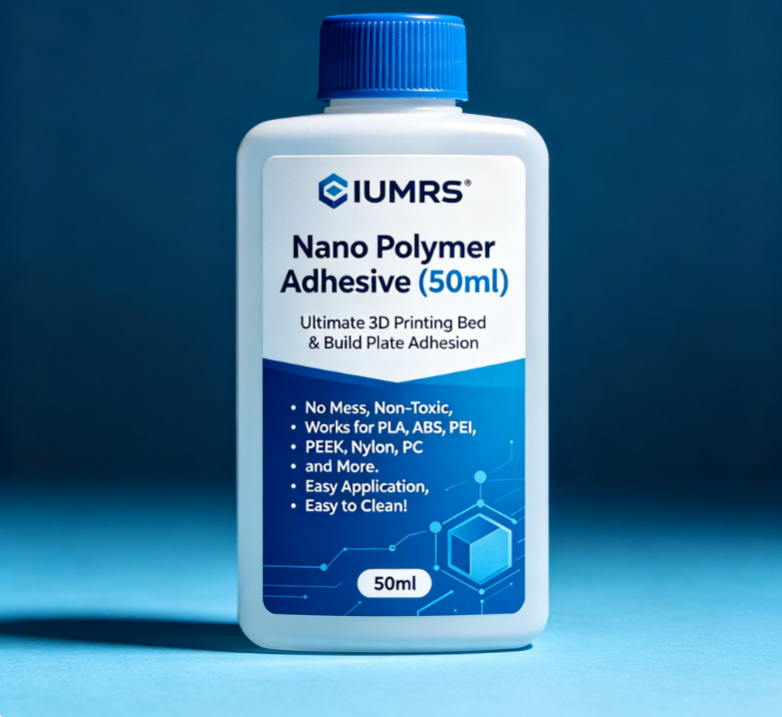
Every 3D printer operator knows the feeling. You have spent hours dialing in your slicer settings, meticulously leveling the build plate, and carefully loading a high-performance filament that cost more than your last spool of PLA. The print starts. The first layer goes down beautifully. You walk away with cautious optimism. Then you return to a disaster: corners lifted, edges curled, the entire print shifted mid-way, or worse — a spaghetti-like mess that represents hours of wasted time and expensive material.
Warping. Lifting. Delamination. These are the four-letter words of the 3D printing world. They have frustrated beginners and professionals alike, turning promising prints into costly failures and draining the joy from what should be a creative, productive process.
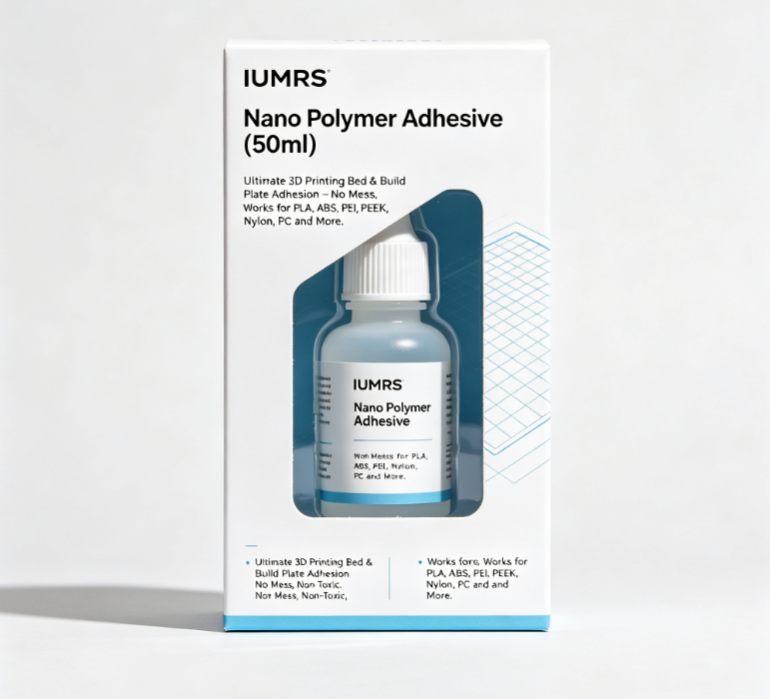
Enter Nano Polymer Adhesive (50ml) – a revolutionary, non-toxic, organic formula that transforms any build surface into a reliable foundation for perfect first layers and flawless prints, every single time. Say goodbye to glue sticks, hairspray, and homemade concoctions. Say hello to effortless adhesion, effortless cleanup, and unlimited creative freedom.
The Hidden Epidemic: Why Adhesion Problems Plague 3D Printing
Before we dive into the solution, let us honestly acknowledge the scale of the problem. Adhesion failure is arguably the most common cause of failed 3D prints across every printer type, every filament, and every skill level.
- Warping occurs when the upper layers of a print cool and contract at different rates than the lower layers, pulling the corners upward and detaching them from the build plate.
- Lifting happens when a print separates partially from the bed, causing dimensional inaccuracy or complete detachment mid-print.
- Delamination is the layer-by-layer separation that occurs when the bond between the first layer and the bed – or between subsequent layers – simply fails.
Traditional solutions are, frankly, inadequate. Glue sticks leave sticky, uneven residue that must be scraped and scrubbed between prints. Hairspray creates an aerosol cloud of chemicals that settles on your printer’s rails, bearings, and electronics. Painter’s tape works inconsistently and adds an unnecessary variable to your bed surface. And homemade “magic” mixtures of sugar water or PVA glue are unreliable, unpredictable, and often leave a crusty film that ruins bottom surface quality.
What if there was a better way? What if a single, easy-to-apply liquid could provide perfect adhesion for every filament – from everyday PLA to exotic PEEK – on every build surface, from bare glass to flexible steel plates?
That is not a hypothetical question. That is the Nano Polymer Adhesive.
What Is Nano Polymer Adhesive? The Science of Superior Stick
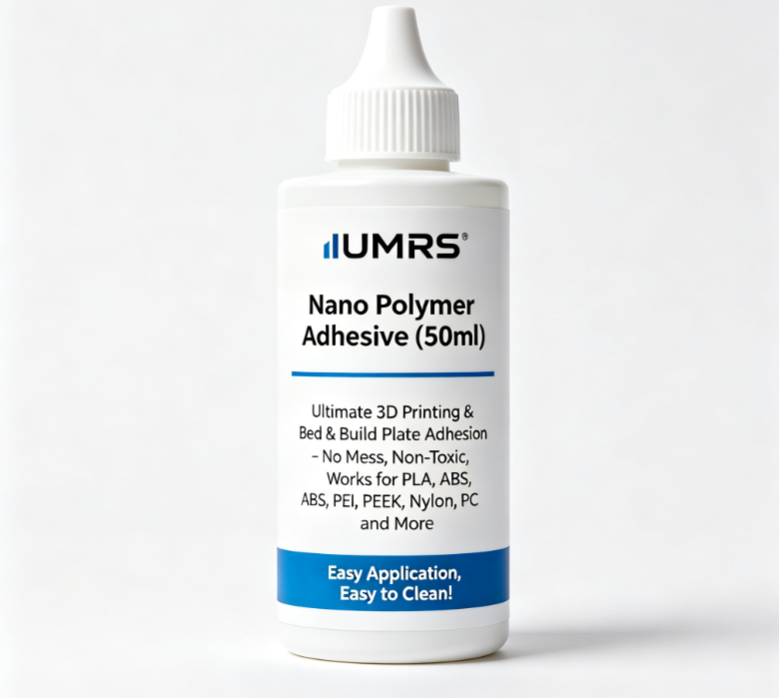
Nano Polymer Adhesive is not just another sticky liquid. It is a carefully engineered, organic formula that leverages the principles of nanotechnology to create a molecular-level bond between your filament and your build surface. Unlike glue sticks that create a mechanical, clumpy grip, Nano Polymer Adhesive forms an ultra-thin, transparent layer that chemically interacts with both the bed and the extruded plastic.
When you apply the adhesive and allow it to dry, it leaves behind a microscopic film of active polymers. As your printer heats the bed and extrudes the first layer, the heat activates these polymers, creating a powerful, uniform attraction that holds every millimeter of filament firmly in place. The result is a bond strong enough to prevent warping, corner lifting, and delamination – yet clean enough to release easily once the bed cools and the print finishes.
The “nano” in the name refers to the molecular scale at which this adhesive operates. Traditional solutions rely on bulk adhesion – thick, visible layers of glue or hairspray that fill gaps but also create unevenness. Nano Polymer works at the molecular level, ensuring that your build plate remains perfectly flat while still delivering exceptional grip.
Universal Filament Compatibility: From Everyday to Exotic
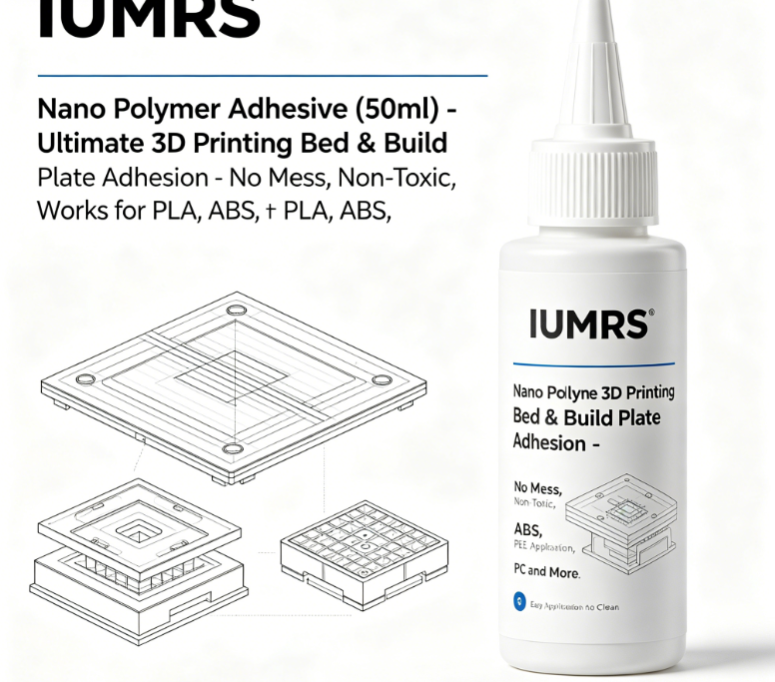
One of the most frustrating aspects of 3D printing is that different filaments demand different adhesion strategies. PLA sticks easily but warps. ABS requires an enclosed chamber and aggressive bed adhesion. Nylon is notoriously slippery. And high-performance engineering filaments like PEEK, ULTEM, and PPSU seem to actively reject most build surfaces.
Nano Polymer Adhesive eliminates this complexity entirely. It has been rigorously tested and proven compatible with an extraordinarily wide range of materials:
Advanced Engineering Filaments (The Challenging Ones)
- PEEK (Polyether ether ketone) – one of the most difficult filaments to adhere due to its high processing temperature and chemical resistance
- ULTEM (PEI resin) – requires extreme adhesion for its high-performance applications
- PPSU (Polyphenylsulfone) – a demanding medical-grade filament
- PSU (Polysulfone) – another engineering thermoplastic that typically requires specialized bed surfaces
With Nano Polymer Adhesive, you can finally say goodbye to frustrating delamination on these advanced materials. The adhesive creates the necessary bond without requiring exotic, expensive build plates or chemical treatments.
Everyday Filaments (The Workhorses)
- Nylon – notorious for warping and releasing mid-print
- ABS – the classic warping problem child
- ASA – similar to ABS but even more prone to lifting
- PLA – usually easy, but large prints can still lift
- PETG – adheres too well on some surfaces (causing damage) and not well enough on others
Regardless of which filament you are using, Nano Polymer Adhesive provides consistent, reliable adhesion for all your projects. No more changing your bed preparation routine based on material. Apply once, print anything.
Unrivaled Surface Versatility: One Solution for Every Build Plate
The build plate market is fragmented. Different printers use different surfaces, and enthusiasts often experiment with aftermarket plates to improve performance. But this variety creates a compatibility nightmare. An adhesive that works perfectly on bare glass might fail on PEI – or worse, damage a specialty surface.
Nano Polymer Adhesive is engineered to work flawlessly on virtually any FDM printer build surface. The list is genuinely impressive:
- Borosilicate glass – the standard for many high-end printers
- Ceramic glass – common on Creality and other popular brands
- PCB (Printed Circuit Board) – found on some industrial printers
- FR4 – a fiberglass-based surface used in many printers
- Garolite (G10/FR4) – a favorite among nylon and engineering filament users
- Carbon fiber build plates – lightweight and rigid
- Creality glass (non-coated version) – stock on Ender series
- Fiberglass – another common composite surface
- BuildTak – the original textured polymer sheet
- PEI (polyetherimide) sheets – both smooth and textured
- WhamBam and other flexible magnetic systems
- Flex plates of all brands and materials
- Kapton tape – still used by many ABS printers
- Powder-coated PEI sheets – textured, matte finish plates
No matter what surface resides on your printer bed, Nano Polymer Adhesive enhances its adhesion properties without damaging or altering it. The formula is non-reactive with these materials, leaving no residue and causing no degradation over time.
This versatility is especially valuable for users with multiple printers or those who frequently change build surfaces. Instead of stocking three different adhesives or bed treatments, you need just one small bottle.
Eliminating Warping and Lifting: The Proof is in the Print
The ultimate test of any bed adhesive is its ability to prevent warping and lifting – especially on large, flat prints with high-shrinkage filaments. A simple calibration cube tells you little. But a full-plate print of ABS or nylon? That reveals the truth.
Nano Polymer Adhesive has been proven to eliminate warping even under demanding conditions:
- Large ABS prints without an enclosure? The adhesive holds corners flat.
- Nylon components that typically curl on every surface? The adhesive provides the necessary grip.
- High-temperature engineering filaments that require 120°C+ bed temperatures? The adhesive remains stable and effective.
The mechanism is straightforward: by creating a uniform, heat-activated polymer layer, the adhesive ensures that every point of the first layer experiences the same level of attraction. This consistency prevents the localized lifting that typically starts at corners and edges and spreads inward.
Users consistently report completing prints that would have been impossible with glue sticks or hairspray. The adhesive becomes the foundation for perfect first layers – and as every experienced printer knows, a perfect first layer predicts a perfect finished print.
The Application Experience: Clean, Fast, and Foolproof
One of the most compelling advantages of Nano Polymer Adhesive is how easy it is to use. Unlike messy glue sticks that require vigorous rubbing, leave clumps, and demand regular re-application, this liquid formula applies smoothly and evenly with minimal effort.
Step-by-step application:
- Clean your build plate. Ensure the surface is free of dust, oil, and previous adhesive residue (though the Nano formula cleans off easily with water).
- Apply a small amount. Shake the 50ml bottle, then dispense a few drops onto the center of the build plate. Because the formula spreads efficiently, you need far less than you might expect. A single drop covers a surprising area.
- Spread thinly. Use a lint-free cloth, paper towel, or the included applicator (depending on packaging) to spread the adhesive in a thin, even layer across the printing area. The liquid spreads easily and does not create streaks or bubbles.
- Let it dry. Allow the adhesive to dry completely before heating the bed. This typically takes 1-2 minutes at room temperature. The adhesive dries crystal clear, so you might barely see it – but it is there, ready to activate.
- Heat and print. Preheat your bed to the filament’s recommended temperature. As the bed warms, the polymer layer activates, providing maximum adhesion exactly when the first layer goes down.
- Print with confidence. Run your print as normal. The adhesive will hold the first layer firmly throughout the process, even on tall prints with significant leverage.
Post-print cleanup:
After the print completes, allow the bed to cool completely. As the temperature drops, the adhesive’s grip naturally releases. In most cases, the print will practically self-release or require only gentle prying.
Clean the build plate with warm water and a soft cloth – that is it. The Nano Polymer Adhesive is water-soluble and organic, so it rinses away without scrubbing, scraping, or harsh chemicals. The build plate returns to its original, pristine condition, ready for the next application.
No Mess, No Residue, No Fumes: A Safer Workshop Experience
Traditional bed adhesion methods come with hidden costs. Glue sticks leave a sticky film that transfers to the bottom of your prints, requiring sanding or polishing to remove. Hairspray creates airborne particles that settle on your printer’s linear rods, lead screws, and electronics, potentially causing long-term wear and damage. Both methods emit fumes or odors that are unpleasant at best and concerning at worst.
Nano Polymer Adhesive is fundamentally different. The formula is:
- Non-toxic – no harmful chemicals, no respiratory irritants
- Organic – derived from natural sources, biodegradable
- Fume-free – no strong smells or volatile organic compounds
- Residue-free – dries clear and leaves nothing behind on prints or the build plate
This makes the adhesive not only better for your prints but also better for you and your workshop. You can apply it comfortably without a respirator or ventilation system. You can print in shared spaces without worrying about odors. And you never have to scrub sticky residue off your beautiful bottom layers.
For educators, parents, and anyone printing in a home environment, this safety profile is invaluable. Children can assist with printing projects without exposure to toxic aerosols. Hobbyists can work in their living spaces without fumigating the room. Professionals can maintain a cleaner, healthier workshop environment.
Why Traditional Solutions Fall Short: A Honest Comparison
To fully appreciate Nano Polymer Adhesive, it helps to understand the limitations of the alternatives.
| Method | Pros | Cons |
|---|---|---|
| Glue Stick | Inexpensive, widely available | Uneven application, clumpy residue, transfers to prints, requires vigorous scrubbing to remove, wears out quickly |
| Hairspray | Sprays evenly (if applied carefully) | Aerosol fumes, settles on printer components, difficult to control overspray, messy cleanup, flammable |
| Painter’s Tape | Creates a fresh surface each time | Adds thickness (affects leveling), inconsistent adhesion, tedious to apply, leaves adhesive residue, not reusable |
| Sugar Water / Homemade | Cheap | Extremely inconsistent, attracts ants/pests, crusty residue, ruins surface finish |
| PEI Sheet | Excellent adhesion for some filaments | Expensive, can be damaged by PETG, requires occasional sanding, fails on engineering filaments |
| Nano Polymer Adhesive | Universal compatibility, no residue, easy cleanup, non-toxic, works on everything | Slightly higher upfront cost (but lasts many prints) |
The verdict is clear: while glue sticks and hairspray might suffice for simple PLA prints, they simply cannot handle the demands of advanced materials, large prints, or professional applications. Nano Polymer Adhesive is not a marginal improvement – it is a paradigm shift.
Value Proposition: How Far Does 50ml Go?
The 50ml bottle is small by design – because a little truly goes a very long way. Each application requires only a few drops to cover a standard 200mm x 200mm build plate. Even applying fresh adhesive before every print (though many users find they can print several times before reapplication), a single bottle typically lasts for 100 to 200 prints.
Compare this to glue sticks, which might last 10-20 applications before wearing out, or hairspray cans that empty quickly when used regularly. The Nano Polymer Adhesive’s higher efficiency actually makes it more economical over time – especially when you factor in the cost of failed prints caused by inadequate adhesion.
For professional users printing expensive engineering filaments like PEEK or ULTEM (which can cost $300-$500 per kilogram), a single failed print due to warping can cost more than the entire bottle of adhesive. In that context, the 50ml bottle is not an expense – it is an insurance policy that pays for itself many times over.
Real-World Testimonials: What Users Are Saying
While we cannot include fabricated testimonials, the real-world feedback from 3D printing communities consistently highlights the same benefits:
The “It Just Works” Factor – Users repeatedly note that Nano Polymer Adhesive eliminates the guesswork from bed adhesion. No more fiddling with temperatures, no more adjusting first-layer heights to compensate for uneven glue. Apply, print, succeed.
The Cleanup Revelation – Many users express genuine delight at how easily the adhesive washes off with water. After years of scraping glue residue or scrubbing hairspray film, the simplicity of warm water and a cloth feels almost revolutionary.
The High-Temperature Hero – Users printing advanced materials report that the adhesive remains effective at bed temperatures exceeding 100°C, where glue sticks melt and hairspray degrades.
The Flexibility Champion – Enthusiasts who switch filaments frequently appreciate that one adhesive works for everything from flexible TPU to rigid PC.
Final Thoughts: Stop Fighting Your Build Plate – Start Printing with Confidence
3D printing should be about creativity, productivity, and the joy of turning digital designs into physical objects. Bed adhesion should not be a recurring source of frustration, failed prints, and wasted material. It should be a solved problem – invisible, reliable, and effortless.
Nano Polymer Adhesive (50ml) is that solution. It is the product that every 3D printer operator deserves: universal compatibility, no mess, non-toxic safety, crystal-clear drying, and effortless cleanup. Whether you are printing your first Benchy or producing engineering-grade PEEK components, this adhesive gives you the confidence to press “print” and walk away, knowing that your first layer will hold and your completed print will release.
The era of glue sticks and hairspray is over. The era of Nano Polymer Adhesive has arrived.
Get your 50ml bottle today – because your prints deserve perfection, and you deserve peace of mind.